If you buy an apartment in Morocco, the price on the deed is not the last bill you will pay for that building.
Every apartment in a co-owned building carries syndic fees, and a seller’s unpaid fees can become your problem the day you sign.
This guide explains what syndic fees in Morocco cover, what the law says about arrears when an apartment changes hands, and exactly which documents to ask for before you commit money.
Quick answer
Syndic fees are your share of the costs of running a co-owned building: cleaning, security, lifts, common electricity, repairs and the manager’s fee. There is no national tariff, so the amount depends on the building and its yearly budget. Under Law 18-00, a buyer is jointly liable with the seller for the seller’s unpaid charges, so ask for the syndic’s written discharge, the latest budget and the general assembly minutes before you sign.
What are syndic fees in Morocco?
In Morocco, apartment buildings, gated residences and many villa complexes are run under a co-ownership system called copropriété.
All the owners are automatically grouped into a syndicate (the syndicat des copropriétaires), and the syndicate appoints a syndic to manage the building day to day.
The syndic can be one of the owners acting as a volunteer or a professional management company.
Law 18-00 on co-ownership says that each owner must contribute to the costs of keeping, maintaining and managing the common parts, and to the shared services and equipment according to how useful they are to each unit (Law 18-00 as amended by Law 106-12, Article 36, consolidated text published by ANCFCC).
Those contributions are what agents and owners call syndic fees or charges de copropriété.
What do syndic fees usually pay for?
- Staff: guards, a concierge, cleaners and gardeners.
- Common utilities: electricity for stairwells, lifts, pumps and outdoor lighting, plus common water.
- Equipment: lift maintenance contracts, water pumps, gates, cameras and intercoms.
- Amenities: pool cleaning and chemicals, gardens and sometimes a gym in larger residences.
- Management: the professional syndic’s fee, bank charges and accounting.
- Repairs and reserves: roof and facade work, waterproofing and any reserve fund the owners decide to build.
How much are syndic fees in Morocco?
There is no official price list, and I would be careful with anyone who quotes you a “normal” figure without showing you the building’s accounts.
Each year the general assembly of owners votes a provisional budget plus a provision for major maintenance work, and owners pay their share in instalments, due on the first day of each quarter or on the dates the assembly sets (Law 18-00, Article 24).
Your share is set by the building’s co-ownership rules, usually in proportion to the size of your unit.
So the real answer to “how much?” is in three documents: the voted budget, your unit’s share, and the syndic’s statement for the last year or two.
What makes one building more expensive than another?
| Building feature | Effect on your charges |
|---|---|
| 24 hour guards and controlled entry | Often the largest line, because several salaries are shared by the owners. |
| Pool and gardens | Water, chemicals, pumps and staff add cost all year, even when you are not there. |
| Lifts | Maintenance contracts, electricity and eventual replacement. |
| Professional syndic company | A management fee on top of running costs, usually with better records. |
| Older building with deferred repairs | Low charges today can hide a large special contribution tomorrow. |
When I was looking at apartments in Marrakech, one of the places I wanted was in a secure residence where only owners could enter, with a pool and other shared facilities.
That deal fell through for other reasons, but it taught me to look at a residence as a monthly running cost, not only as a lifestyle feature.
Every guard, pump and lift you admire on the visit is paid for by the owners every month.
Already considering a property?
See the 14 Day Buyer Plan: $299 →Get 14 days of personal buyer support, three private calls and WhatsApp support.
Get help reviewing up to three properties before you commit money.
Can you inherit the seller’s unpaid syndic fees?
Yes, and this is the point most foreign buyers miss.
When a unit is sold, the law makes the buyer jointly liable with the seller for the seller’s debts to the syndicate, and the syndicate can claim those arrears from the buyer using the fast payment order procedure (Law 18-00, Article 42).
Jointly liable means the syndicate does not have to chase the seller first.
If the seller has left Morocco with the sale money, you may be the easiest person to collect from.
The same law also gives the syndicate a forced mortgage (hypothèque forcée) on a debtor owner’s unit, which a court can order to be registered on the unit’s land title (Law 18-00, Articles 40 and 40 bis).
That is one more reason to read a fresh property certificate from ANCFCC, not an old copy supplied by the seller.
Claims for common charges expire if they are not claimed within five years of the general assembly approving them (Law 18-00, Article 43).
In practice, that means several years of a seller’s arrears can still be collectable when you buy.
What document protects you?
Among the syndic’s legal duties is to give a selling owner a discharge receipt (récépissé de décharge) when that owner owes nothing to the syndicate (Law 18-00, Article 26).
Ask your notary to obtain that document, dated close to the signing, and to keep it in the file.
If the seller does have arrears, the cleanest solution is for the notary to pay them to the syndicate out of the sale price before the seller is paid.
Our guide to notary fees and what the notary handles when you buy explains how the notary’s role fits into the rest of the transaction.
Which documents should you ask for before signing?
Ask for these before you sign a compromis de vente or pay a deposit, not at the final signing.
- The règlement de copropriété: the building’s rules. The seller must give the buyer a copy, together with the architectural and topographic plans of the unit, and the sale deed must state that the buyer has read them (Law 18-00, Article 11).
- The latest voted budget: with the unit’s share and the payment schedule.
- The last two or three general assembly minutes: these show disputes, planned works and anything already voted but not yet billed.
- The syndic’s statement for the unit: what the seller has paid and what is outstanding.
- Details of any reserve account: the law allows owners to create one for unusual or urgent expenses (Law 18-00, Article 37 bis).
- The syndic’s discharge receipt: obtained through the notary, close to completion.
Questions to ask the syndic directly
- How much do I pay each quarter, and has that amount changed in the last three years?
- Have any major works been voted, and how will they be billed?
- What share of owners are behind on their payments?
- When was the lift last serviced, and is a replacement planned?
- Do the building rules allow short term holiday rentals?
- Is there any legal action between the syndicate and an owner or the developer?
A building where many owners do not pay is a warning sign.
The paying owners end up carrying the costs, maintenance slips, and the building becomes harder to resell.
These checks sit alongside the title, ownership and permit checks in our property due diligence checklist for foreign buyers.
How do syndic fees change your rental return?
Syndic fees are paid whether the apartment is rented, empty or used by you two weeks a year.
Here is a hypothetical example to show the scale, not a market figure.
Assume charges of 500 dirhams a month and a long term rent of 4,000 dirhams a month.
That is 6,000 dirhams a year of charges against 48,000 dirhams of rent, so 12.5% of your gross rent goes to the building before tax, repairs, empty months or management.
For short term rentals the comparison is harder, because the charges stay fixed while occupancy goes up and down with the seasons.
Put the real figure from the building’s budget into your numbers before you compare Airbnb and long term rental returns in Marrakech.
Are syndic fees the same as property tax?
No.
Syndic fees go to the owners’ syndicate for the building.
Local taxes such as the housing tax and the municipal services tax are separate and are paid to the authorities, as explained in our guide to the property taxes foreign owners pay every year.
Your yearly ownership budget should include both.
Already considering a property?
See the 14 Day Buyer Plan: $299 →Get 14 days of personal buyer support, three private calls and WhatsApp support.
Get help reviewing up to three properties before you commit money.
What happens if you stop paying syndic fees?
This matters if you plan to own from abroad and let bills pile up while you are away.
If an instalment is not paid, the syndic can send a formal notice by registered letter, and if it stays unpaid for more than thirty days, the remaining instalments for the year become due at once (Law 18-00, Article 25).
The syndic does not need the general assembly’s permission to go to court, and the president of the court of first instance can issue a payment order based on the assembly minutes and the owner’s account (Law 18-00, Articles 25 bis and 36 bis).
Unpaid charges can then lead to a forced mortgage on your unit, which will have to be cleared before you can sell cleanly.
If you live abroad, give the syndic a correspondence address you actually check, and set up a standing payment through your Moroccan bank account.
If you think your share of the charges is too high, the law lets you ask the competent court to review it (Law 18-00, Article 38).
Stopping payment is not the way to protest.
Is a new build or a resale apartment safer on charges?
Each has its own risk.
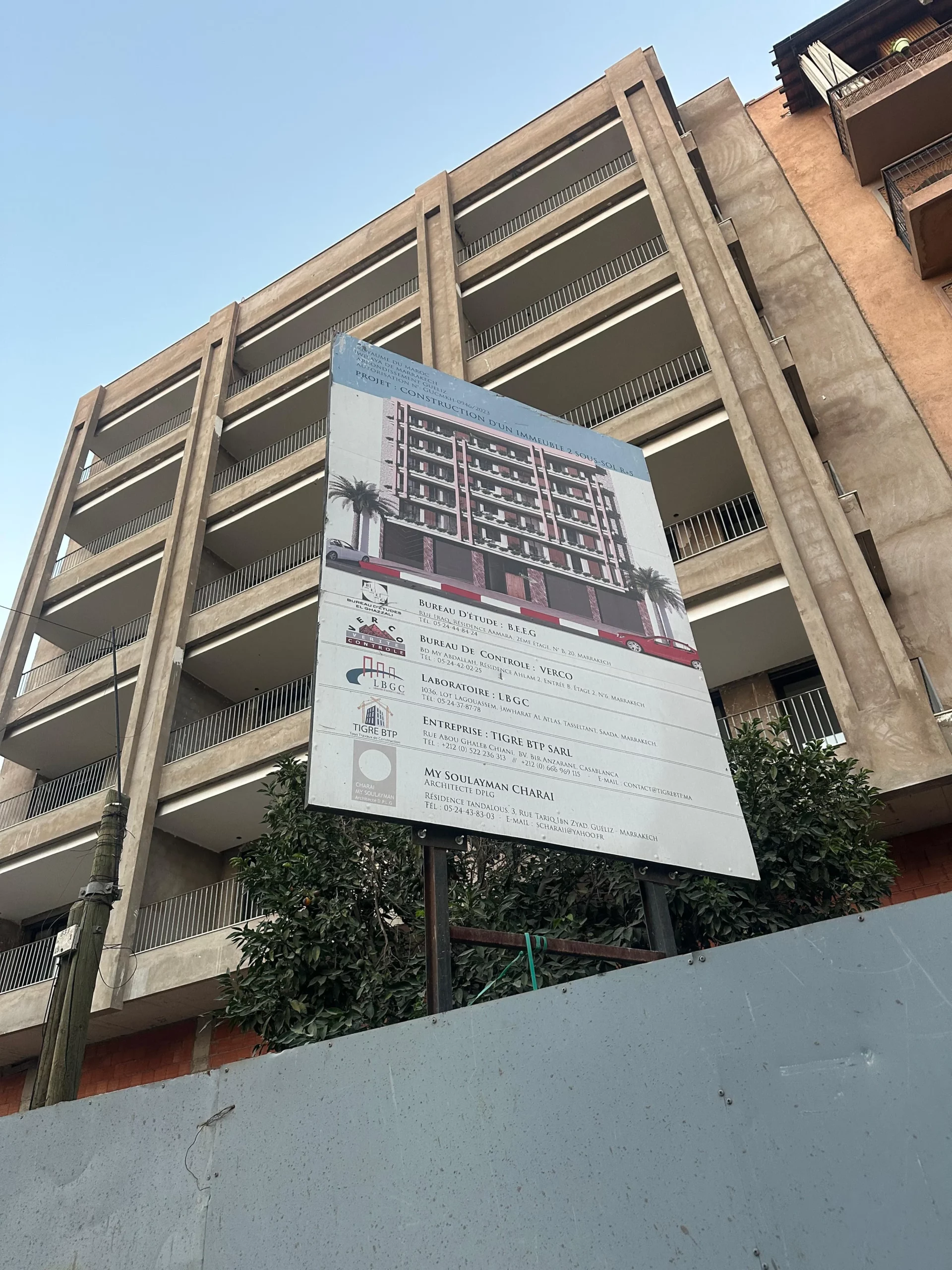
In a new residence, the first budget is often an estimate set while the developer still controls the building, and the real costs only appear once the owners take over.
In a resale building, you can see years of accounts, but you also inherit years of wear, past decisions and possibly a seller’s arrears.
For a new build, ask the developer when the first general assembly will be held and who will act as syndic until then.
For a resale, insist on the minutes and the statement described above.
We compare the two options in more depth in new build or resale apartment in Marrakech.
Syndic checklist before you pay a deposit
- I have a copy of the règlement de copropriété and the unit’s plans.
- I know the unit’s yearly charges from the voted budget, not from the agent.
- I have read the last general assembly minutes and know of any voted works.
- I have the syndic’s statement showing the seller’s account.
- The building rules allow the use I plan, including short term rental if that is my plan.
- The notary will obtain the syndic’s discharge receipt and settle any arrears from the sale price.
- My rental or holiday budget uses the real charges figure.
Frequently asked questions
Who pays syndic fees when the apartment is rented?
The owner owes the charges to the syndicate. Whether you pass part of them to your tenant depends on what your lease says, so write it clearly in the lease. If the tenant does not pay you, the syndicate can still claim from you.
What if the building has no syndic?
Under Law 18-00, the owners form a syndicate automatically from the registration of the first sale in the building. If nobody is actually managing it, expect poor maintenance and no reliable records. Ask the notary how that affects your purchase before you commit.
Can the seller and I agree that I will not pay their arrears?
You can agree that between yourselves, but the law still lets the syndicate claim the arrears from you as buyer. The practical protection is to have the notary settle the arrears from the sale price and to obtain the syndic’s discharge receipt.
Do villas pay syndic fees too?
Villas inside a gated complex with shared roads, gardens, pools or security are often managed under a co-ownership system, so yes, many do. A standalone villa on its own title with no shared parts usually does not. Check the documents for the specific property.
What should you do before making an offer?
Treat syndic fees as part of the price.
Get the real figures from the building’s own documents, make sure the seller’s account is clear, and let the notary handle any arrears before the seller is paid.
The co-ownership law has been amended over time, so ask your notary to confirm that the rules above still apply on the day you sign.
If you are still choosing a building, our guide to buying an apartment in Marrakech safely covers areas, prices and the legal steps around these checks.
Already considering a property?
See the 14 Day Buyer Plan: $299 →Get 14 days of personal buyer support, three private calls and WhatsApp support.
Get help reviewing up to three properties before you commit money.
This guide is general information based on the consolidated text of Law 18-00 as amended by Law 106-12, checked on 11 October 2026. It is not legal advice. Confirm the current rules and the figures for your building with a Moroccan notary or lawyer before you commit money.

Anis is the founder of Buy Property Morocco, a research-based resource created to help foreign buyers understand the real process of buying property in Morocco safely.
He focuses on the practical details most buyers only discover too late: title deed checks, notary steps, compromis de vente risks, transfer taxes, foreign banking rules, repatriating money after a sale, and avoiding common mistakes when dealing with agents or sellers.
Anis has personally bought 4 properties in Morocco and shares practical guidance based on real experience, not theory.
If you are seriously considering buying property in Morocco and want private guidance before you send money, pay a deposit, or sign anything, you can book a buyer safety call here: