
Yes, a US citizen can legally buy a house in Morocco. For eligible titled urban property, US citizens can usually own under broadly similar ownership protections as Moroccan buyers. But the costliest mistake I see Americans make is not legal. It is trusting a seller’s title before their own notary has pulled a fresh copy from the land registry. What happens in the 30 days after you sign a promise of sale matters far more than whether the law allows you to buy.
At a Glance: Morocco Property for US Citizens
- US citizens can own urban residential property such as apartments, villas, and riads, provided the property sits on a registered titre foncier.
- Agricultural land is legally restricted to Moroccan nationals, with narrow exceptions for certified non-agricultural investment projects.
- Budget 7% to 10% of the purchase price for closing costs including registration duty, notary fees, land registry, stamps, and agent fees. Verify current rates with your notary before signing.
- Every real property sale must go through a Moroccan notary, who is legally responsible for collecting your taxes and registering your title.
- Funds must enter Morocco through regulated banking channels to protect your right to send money home when you eventually sell.
- No residency or Moroccan visa is required to buy. A tourist entry is enough.
- The single most dangerous phrase in a Moroccan property deal is “the title is being processed.”
Already considering a property?
See the 14 Day Buyer Plan: $299 →
Get 14 days of personal buyer support, three private calls and WhatsApp support.
Get help reviewing up to three properties before you commit money.
How This Actually Works in Morocco

Morocco uses a civil law system built around the notary (notaire) and a centralized land registry called ANCFCC, the Agence Nationale de la Conservation Foncière, du Cadastre et de la Cartographie. A property is legally real to the state only when it has a titre foncier, a unique registered land title number. Everything else is a claim, not a title.
Foreigners including US citizens can hold registered ownership of eligible urban titled property when the property has a clean titre foncier. The US State Department’s Morocco Investment Climate Statement confirms there are no nationality-based restrictions on standard urban residential property. The one hard wall is agricultural land, which remains reserved for Moroccan citizens under the real property code, Law 39.08, with narrow exceptions for projects that obtain a non-agricultural vocation certificate.
What “titled” really means
A titre foncier is registered with ANCFCC and carries a unique number, official boundaries, the registered owner’s name, and any mortgages or legal charges on the property. Old-style melkia documents are traditional unregistered deeds. They are not the same thing, and every year foreign buyers lose money confusing the two.
Step by Step: The Real Buying Process

- Find the property and visit it in person. Photos lie, especially in the Medina.
- Ask for the title number (numéro de titre foncier) in writing. If the seller cannot give it to you, walk away.
- Hire your own notary. Not the seller’s notary. This is non-negotiable.
- Your notary orders a fresh certificat de propriété from ANCFCC. This confirms the current owner, the boundaries, and any mortgages, liens, or disputes on the property.
- Sign a compromis de vente (promise of sale) with a 5% to 10% deposit held by the notary, not by the agent, not by the seller.
- Wire your purchase funds into Morocco through a bank, and make sure your bank issues a Formule 2, proof of foreign currency entry. This single document protects your right to send money home later.
- The notary schedules the acte de vente (final deed). You sign. The balance is paid into the notary’s account.
- The notary pays all taxes on your behalf, files the transfer at ANCFCC, and issues you a new titre foncier in your name.
- Keep every receipt, every wire confirmation, every tax stamp. Forever.
Documents US Citizens Usually Need When Buying Property in Morocco
Every deal is slightly different depending on the property, the notary, and whether you are buying remotely or in person. That said, most notaries will ask for some or all of the following. Confirm the exact list with your notary before the signing date.
- Valid US passport
- Proof of funds, usually bank statements or a letter from your bank
- Bank transfer records showing funds entered Morocco through regulated channels
- Source of funds explanation if requested by the bank or notary
- Moroccan tax identifier (identifiant fiscal) if required by the notary or tax authority
- Power of attorney if you are buying remotely and not present at signing, prepared and signed at a Moroccan consulate abroad
- Sworn translations of documents not in French or Arabic
- Marriage, divorce, or inheritance documents if relevant to your ownership structure
Can a US Citizen Get Moroccan Citizenship by Buying a House?
No. Buying a house in Morocco does not give an American Moroccan citizenship. Morocco does not currently offer citizenship by investment or a real estate passport program. Property ownership, residency, and citizenship are entirely separate legal matters in Morocco. Buying property may in some situations support a broader case for financial stability, but it does not create an automatic or guaranteed path to citizenship. Americans can own eligible titled urban property without becoming Moroccan citizens or obtaining Moroccan residency.
If you are interested in Moroccan residency separately, that is a distinct application process with its own requirements. Speak with an immigration lawyer based in Morocco for current advice on residency options.
Safe Route vs Risky Route
| Situation | Safe Route | Risky Route |
|---|---|---|
| Paying the deposit | Paid into notary escrow account | Paid to agent or seller directly |
| Verifying the title | Fresh ANCFCC certificat de propriété ordered by your notary | Accepting a photocopy from the seller |
| Sending money | Bank wire with Formule 2 proof of foreign currency entry | Cash payment or informal transfer |
| Choosing a notary | Your own independent notary | Using the seller’s notary only |
| Title document | Registered titre foncier with ANCFCC number | Melkia or a title described as “in process” |
| Refund terms | Written refund conditions in the compromis de vente | Vague verbal promise from the agent or seller |
Biggest Mistakes Foreigners Make
- Paying the deposit to the agent or the seller directly instead of into the notary’s escrow account.
- Using the seller’s notary because it “saves time.” Notaries are supposed to be neutral, but convenience tends to travel with the seller.
- Relying on melkia or photocopied documents instead of insisting on a live, registered titre foncier.
- Wiring money from an offshore account, or paying part in cash “to reduce tax.” This quietly destroys your repatriation rights.
- Signing French or Arabic documents without a sworn translation.
- Skipping the search for encumbrances, inheritance claims, and unpaid municipal taxes.
- Trusting a verbal reassurance that a rural plot “can be built on.” Without the vocation non agricole certificate on paper, it often cannot.
Already considering a property?
See the 14 Day Buyer Plan: $299 →
Get 14 days of personal buyer support, three private calls and WhatsApp support.
Get help reviewing up to three properties before you commit money.
Hidden Risks Nobody Tells You
Fake titles and photocopied documents
Scammers in Marrakech and Casablanca regularly present photocopied or outdated titles with missing ANCFCC seals. Your notary must pull a live registry extract, not accept the seller’s copy. Industry reporting has documented that a significant share of reported real estate fraud cases in Morocco involve foreign buyers, most of whom paid before verification.
Double selling
One property, several deposits, from several buyers. Only the first buyer to register at ANCFCC legally wins. That is why the deposit must sit in the notary’s account, and the promise of sale should be registered in writing the same day.
The inheritance trap
Many riads in the Marrakech Medina have 6, 10, sometimes 20 registered heirs spread across generations and countries. If even one heir has not consented in writing, the deed can be contested for years. This is one of the most common reasons I have seen a foreign buyer end up locked out of their own property.
The non-agricultural trick
A seller claims a rural plot has been reclassified for villa construction. Ask for the vocation non agricole certificate, issued on paper by the provincial authorities and stamped. No certificate, no deal. No exceptions.
The repatriation trap
If you do not bring your purchase funds in through regulated banking channels and obtain a Formule 2, Morocco’s Office des Changes may block or delay your sale proceeds when you eventually resell. Without the repatriation guarantee, funds may be released in stages over several years through a compte convertible à terme. Confirm the exact rules with your bank and notary before wiring any funds, as exchange control regulations can change. Even a legal, titled property becomes a trapped asset if the money trail is wrong from day one.
Costs, Taxes, and Real Numbers
Below is what a US buyer typically pays on a standard titled residential property, based on rates from Morocco’s DGI tax authority and ANCFCC. These rates can change. Always confirm the current figures with your notary before signing.
| Cost | Rate | On 1,000,000 MAD (approx. $100,000 USD) |
|---|---|---|
| Registration duty (droits d’enregistrement) | 4% standard, 3% qualifying social housing, up to 6% on unbuilt land. Verify with your notary. | Around 40,000 MAD at standard rate |
| Land registry (Conservation Foncière) | Around 1.5% plus fixed fees | Around 15,000 MAD |
| Notary fees (honoraires) | Approximately 0.5% to 1.5% plus VAT | 10,000 to 18,000 MAD |
| Stamps and administrative costs | Around 1% | Around 10,000 MAD |
| Real estate agent if used | 2.5% to 5% | 25,000 to 50,000 MAD |
| Independent lawyer and sworn translations (recommended) | Fixed, varies by case | 5,000 to 15,000 MAD |
| Realistic total range | 7% to 11% | 70,000 to 110,000 MAD |
Recurring taxes after purchase
- Taxe d’habitation: annual residential tax, with potential exemptions for newly built primary residences in the early years. Confirm current rules with a tax adviser.
- Taxe de services communaux: annual municipal services tax.
- Rental income tax: foreign landlords pay progressive rates. Confirm current rates with a Moroccan tax adviser before renting.
- Capital gains tax (TPI): applies on resale gains, with exemptions in some cases for a primary residence held for a minimum period. Verify current exemption rules with your notary or tax adviser before selling.
How to Verify Everything Safely
- Get the title number in writing from the seller.
- Cross-check it yourself on Morocco’s Mohafadati portal, which is ANCFCC’s official online title lookup.
- Have your own notary order a fresh certificat de propriété.
- Ask for the seller’s national ID (CIN) or passport and confirm the name matches the registered owner exactly.
- Request tax clearance certificates covering local taxes and any pending capital gains.
- For condos, request the syndic records and confirmation that monthly charges are fully paid.
- For a riad or villa, verify the building permit (permis de construire) and occupancy certificate.
- Route every payment through a Moroccan bank and keep your Formule 2.
What I Have Actually Seen Happen
These are real patterns, simplified for privacy. If you think they are rare, they are not.
The American couple in Gueliz who lost a 150,000 MAD deposit
They wired the deposit to a “reservation account” that turned out to be a personal account belonging to the agent’s cousin. When they asked for a refund, the agent stopped answering. The seller claimed he had never received the money. Because the deposit was never paid to a notary, there was no legal record tying it to the sale. Two years later they settled in court for half, minus legal fees.
The New Yorker who bought a beautiful Medina riad with 14 invisible heirs
Dreamy property. Confident “family representative.” Casual signing. Eighteen months after the sale, three heirs surfaced from abroad and contested the deed. The property was blocked at the registry pending a Moroccan court ruling. He could not sell, could not renovate, and could not legally rent for almost three years.
The retiree who paid 40% in cash “for tax purposes”
He was told cash would reduce registration duty. He signed for the lower official amount and handed the rest over in euros. Five years later he wanted to resell and move the money to Arizona. The Office des Changes could not authorize the full transfer because only 60% of the purchase was documented through banking channels. The “savings” became a permanent lock on 40% of his capital.
The family that trusted the seller’s notary
The notary was real, the title was real. But the boundaries on the title were old and did not match the fence on the ground. A neighbor later proved the garden had been annexed decades earlier. A buyer’s own notary would have ordered a fresh land survey. The seller’s notary had skipped it.
What Most Websites Will Not Tell You
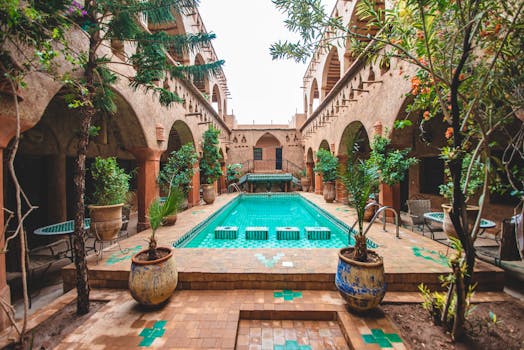
- Marrakech is really two property worlds. The Medina is old, walled, and riad-heavy, with complex titles and inheritance chains. The Ville Nouvelle including Gueliz, Hivernage, and Agdal is modern, cleaner on paperwork, and priced higher per square meter. Confusing the two is a financial mistake.
- In the Medina, an unusually low price is almost always a title problem, not a bargain. Clean riads at a real discount simply do not sit on the market.
- “Buy through a Moroccan SARL” is often pitched to foreigners as a shortcut. It has legitimate uses for commercial rental, multiple owners, or inheritance planning, but for a single-family home it usually adds accounting costs and tax complications, not savings.
- Foreign buyer mortgages exist at some Moroccan banks, but they typically require a substantial down payment and heavy paperwork. Conditions vary and change, so confirm current terms directly with the bank before relying on any figures. Most serious foreign buyers pay cash.
- You can buy without being physically present, using a power of attorney signed at a Moroccan consulate abroad. It is legal and it doubles the importance of an independent notary you trust.
- Your notary is not your lawyer. Notaries are neutral by law. For complex cases involving inheritance, joint owners, boundary disputes, or off-plan purchases, also hire a separate avocat.
- The Moroccan dirham is not freely convertible. Bring dollars in through a Moroccan bank, always. Never through informal money changers or offshore accounts.
- Prices in Marrakech are often quoted in euros informally, but the legal contract must state a dirham price. The dirham figure on the deed is what counts for registration tax, capital gains, and repatriation.
- Rental yields on well-located riads can look attractive on paper, but real-world occupancy, management costs, and maintenance on a 200-year-old building rarely match the agent’s spreadsheet.
- Long-term leases (emphytéotique) are capped under Moroccan law and do not automatically renew, despite what some sellers may suggest. Confirm the exact rules with your notary. Only a registered titre foncier gives you freehold-style security.
French and Arabic Property Terms Glossary
These terms appear in almost every property transaction in Morocco. Knowing what they mean before you sit down with a notary or agent will save you confusion.
| French Term | Arabic | What It Means |
|---|---|---|
| Titre foncier | الرسم العقاري | The registered land title. The only document that gives you full legal ownership recognized by the state. |
| Certificat de propriété | شهادة الملكية | A live certificate pulled from the ANCFCC registry confirming the current owner, boundaries, and any charges on the property. |
| Notaire | النوتير | The notary. A legally appointed officer who handles the sale, collects taxes, and registers the transfer. Required for every property sale. |
| Compromis de vente | وعد بالبيع | The promise of sale agreement. Signed after agreeing on price, with a deposit typically paid into the notary’s escrow account. |
| Acte de vente | عقد البيع | The final sale deed. Signed before the notary. This is when full payment is made and ownership legally transfers. |
| Conservation Foncière | المحافظة العقارية | The land registry office, part of ANCFCC. Where your new titre foncier is filed after the sale completes. |
| Vocation non agricole / AVNA | Often discussed in French in Moroccan property paperwork | A certificate issued by provincial authorities confirming a rural plot has been reclassified as non-agricultural. Required before building or buying for residential use on rural land. |
| Formule 2 | Often discussed in French in Moroccan property paperwork | Proof of foreign currency entry issued by your Moroccan bank. This document is what protects your right to repatriate sale proceeds later when you sell. |
Frequently Asked Questions
Can a US citizen buy a house in Morocco?
Yes. US citizens can legally buy titled urban residential property in Morocco. No nationality restriction applies to standard residential property with a clean titre foncier. Agricultural land is a separate matter and is restricted to Moroccan nationals in most cases.
Can an American own land in Morocco?
Yes, for urban residential land with a registered titre foncier. The land must not be agricultural. For eligible titled urban plots, Americans can hold ownership under broadly similar protections as Moroccan buyers. Confirm the land classification with your notary before signing anything.
Can Americans buy agricultural land in Morocco?
No, not directly. Agricultural land is legally restricted to Moroccan nationals under the property code. The narrow exception applies to investment projects that obtain a vocation non agricole certificate reclassifying the land. This is a legal process, not a verbal assurance. Require the certificate in writing before proceeding.
Can a US citizen buy a riad in Marrakech?
Yes, if the riad has a clean registered titre foncier. Many riads in the Marrakech Medina carry complex inheritance situations with multiple heirs, older title structures, or boundaries that have not been updated for decades. This makes due diligence more important for a Medina riad than for a modern apartment in Gueliz or Agdal. See the legal risks of buying a riad in Marrakech for more detail.
Does buying property in Morocco give residency?
No, not automatically. Property ownership does not give you Moroccan residency. Residency requires a separate application process with its own conditions. Speak with a Moroccan immigration lawyer if residency is part of your plan.
Does buying property in Morocco give citizenship?
No. Morocco does not offer citizenship by investment or a real estate passport program. Buying a house, however valuable the property, does not create a path to Moroccan citizenship. Property ownership, residency, and citizenship are entirely separate under Moroccan law.
Can an American buy property in Morocco without being there?
Yes. You can complete the purchase remotely using a power of attorney. The power of attorney must be signed at a Moroccan consulate abroad and notarized. Buying remotely makes choosing an independent notary you trust even more important. Never rely solely on someone you have only met by email or phone to manage a transaction of this size.
Can a US citizen get a mortgage in Morocco?
Some Moroccan banks do offer mortgages to foreign buyers, but the conditions are more demanding than for Moroccan residents. Down payment requirements and documentation requirements are typically higher. Conditions and eligibility vary by bank and change over time. Contact Moroccan banks directly for current mortgage terms and do not rely on general estimates when planning your financing.
How much are closing costs when buying property in Morocco?
Budget between 7% and 11% of the purchase price as a realistic total, covering registration duty, land registry fees, notary fees, stamps, and agent fees if applicable. VAT may apply on new-build properties sold by developers. These figures are based on current official rates but can change. Always confirm the exact costs with your notary before committing to a deal.
Is it safe to pay a deposit before the notary?
No. The deposit must go into the notary’s escrow account, never to the agent or seller directly. If there is no notary account holding the deposit, you have no legal protection if the deal collapses. This is one of the most common and most costly mistakes foreign buyers make in Morocco.
Should Americans use the seller’s notary?
No. Notaries are legally neutral, but a notary introduced by the seller is unlikely to scrutinize the deal with the same care as one you chose yourself. Always hire your own independent notary. The cost is the same and the protection is substantially greater.
Can an American get Moroccan citizenship by buying a house?
No. An American cannot get Moroccan citizenship simply by buying a house in Morocco. Morocco does not currently offer a citizenship by investment program or real estate passport route. You can own eligible titled property as an American, but citizenship is a separate legal process with its own requirements.
Can Americans rent out property in Morocco?
Yes. Foreign owners can rent out titled property in Morocco. Rental income is taxable in Morocco, and the rates depend on whether the rental is furnished or unfurnished and how the income is reported. Confirm current rental income tax rates with a Moroccan tax adviser before signing a lease with a tenant.
Already considering a property?
See the 14 Day Buyer Plan: $299 →
Get 14 days of personal buyer support, three private calls and WhatsApp support.
Get help reviewing up to three properties before you commit money.
Sources and authoritative references: ANCFCC, DGI, Office des Changes, US Department of State Morocco Investment Climate Statement, and Chambers Global Practice Guide: Real Estate Morocco 2025.
Regulations cited here may change.
Always confirm current rules with a registered Moroccan notary, tax adviser, bank, or official source before committing funds.

Anis is the founder of Buy Property Morocco, a research-based resource created to help foreign buyers understand the real process of buying property in Morocco safely.
He focuses on the practical details most buyers only discover too late: title deed checks, notary steps, compromis de vente risks, transfer taxes, foreign banking rules, repatriating money after a sale, and avoiding common mistakes when dealing with agents or sellers.
Anis has personally bought 4 properties in Morocco and shares practical guidance based on real experience, not theory.
If you are seriously considering buying property in Morocco and want private guidance before you send money, pay a deposit, or sign anything, you can book a buyer safety call here: