
Home insurance in Morocco is not compulsory for owners, but if you are a foreigner with a holiday home or a rental flat, it is your main protection against earthquakes and floods.
Insurance pays after the damage, so it is worth checking first how earthquake resistant the building you are buying really is.
The state solidarity fund only compensates damage to a home that is the household’s main residence, lived in at least six months a year, so a home you visit a few weeks a year is usually outside it.
I’m Anis Chity. I’ve bought four properties in Morocco, including an investment property in Marrakech, while my own home is about 80 km away. Owning in a city you don’t live in is exactly the situation this guide is about.
The September 2023 Al Haouz earthquake made the question concrete: the official catastrophe declaration that followed included the prefecture of Marrakech (FNH, October 2023).
Quick answer
There is no general legal obligation to insure your home in Morocco. Insurance becomes necessary in practice when a bank lends you money, when your building’s general assembly has voted a collective policy, when a lease requires it, or when you run a licensed tourist rental.
Every multirisk home policy automatically includes the catastrophic events cover, which only pays after the Head of Government declares the event a catastrophe. Insure from completion day, declare honestly how often the home is occupied and whether it is rented, and get any exclusions confirmed in writing.
This guide is general information based on Moroccan texts checked on 24 October 2026, not insurance or legal advice. Confirm your cover with a licensed insurer or broker.
Is home insurance compulsory in Morocco?
No. The insurance regulator ACAPS states that comprehensive home insurance is not legally required for homeowners or tenants (ACAPS, multi-risk home insurance).
In practice, though, several situations push you into having a policy:
| Your situation | Is insurance required? | Why |
|---|---|---|
| Holiday home or owner occupied home, no loan | No, but strongly advised | No general obligation (ACAPS) |
| Home bought with a Moroccan mortgage | Often, as a loan condition | The bank’s loan contract, not a law |
| Apartment in a co-owned building | The building policy exists only if the owners voted it | General assembly decision (Law 18-00, article 21); your own contents and liability are separate |
| Licensed tourist accommodation | Yes | Fire, theft of guests’ belongings and civil liability (Law 80-14, articles 16 and 34) |
| Home let to a long term tenant | Only if the lease says so | Check the insurance clause in the lease |
An operator who fails to take out or renew the required policy faces a fine of 50,000 to 500,000 dirhams, reduced to 10,000 to 100,000 dirhams for a homestay (hébergement chez l’habitant) (Law 80-14, article 44).
A court can also order the place closed for up to six months.
The rules could change: in January 2025 the press reported that ACAPS had launched a study on making home insurance compulsory (le360, January 2025), but we found no law adopting it as of October 2026.
What does a multirisque habitation policy cover?
The standard product is called multirisque habitation, a multirisk home policy that bundles several guarantees in one contract.
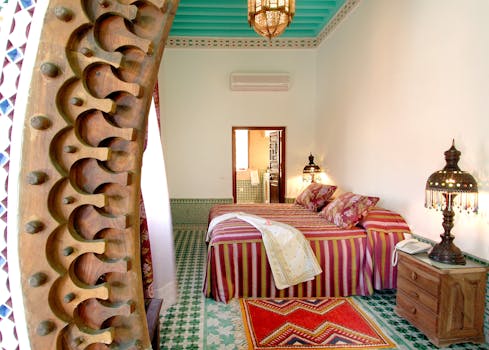
Which guarantees come in a standard policy?
According to ACAPS, a multirisk home policy typically covers:
- Fire and related events: fire, explosion, implosion, lightning and smoke.
- Water damage: leaks and escapes from plumbing, appliances and heating, and frost damage to fixed pipes.
- Glass breakage: windows and glazed doors.
- Optional extensions: for example riots or the cost of searching for a hidden leak.
ACAPS does not list theft in its summary, but press reports describe it as part of basic offers (le360, January 2025).
Each insurer defines it, so check that it is in your contract and what conditions apply, such as locks or grilles.
Why does civil liability matter so much for a foreign owner?
ACAPS lists four kinds of liability a home policy can include: liability to neighbours and third parties, a tenant’s liability to the owner, the owner’s liability to tenants, and private life liability (ACAPS).
Moroccan law makes owners responsible for maintaining their buildings, and liable for damage caused by a partial collapse that results from a construction defect, poor maintenance or deterioration (Law 94-12, article 3).
That is very relevant to old medina houses, as we explain in the legal risks of buying a riad.
If a balcony, a parapet or a wall of your property damages a neighbour’s house or injures a passer by, the liability guarantee is the part of the policy designed to respond.
Check for exclusions linked to poor maintenance, since poor maintenance is also the basis of the owner’s liability.
A building inspection before you buy also helps you know what you are insuring.
What should you read before you sign?
Ask for the conditions générales and the conditions particulières, the general and specific terms, and read four things:
- The value you declare for the building and for the contents, and whether the building value should be the cost of rebuilding rather than the purchase price, which includes the land.
- The deductible, the part of each claim you pay yourself.
- Any clause about the home being unoccupied for long periods.
- Whether paid guests or tenants change the cover.
Many policies reduce the payout if the values you declared are too low, so ask the insurer how this works in your contract.
Does home insurance in Morocco cover earthquakes and floods?
Yes, but only through a special regime, and only after an official declaration.
Law 110-14 added a catastrophic events cover to the Insurance Code. Every property damage policy must include it, and a policy is treated as including it by law (Law 110-14, article 64-1 of the Insurance Code).
For property insurance, ACAPS says the price of this cover is 8% of the base premium, with a maximum of 100,000 dirhams (ACAPS information sheet on catastrophic events).
What counts as a catastrophic event?
The law covers natural events of abnormal intensity, such as earthquakes and floods, and violent human acts such as terrorism or riots (Law 110-14, article 3).
The cover only applies after the Head of Government declares the event catastrophic by an official order, issued within three months (article 6).
Two recent examples show how this works:
- Al Haouz earthquake: the order of 13 October 2023 was published in the Bulletin Officiel on 19 October and covered several provinces, including the prefecture of Marrakech (FNH).
- Gharb and Loukkos floods: on 12 February 2026 an official statement announced that the Head of Government had declared the floods in the provinces of Larache, Kénitra, Sidi Kacem and Sidi Slimane catastrophic (Le Matin).
What do you have to do, and what will you get?
You must tell your insurer about the event as soon as you know of it, and at the latest within 20 days (article 64-5).
According to ACAPS, for a residential building the payout under this cover is capped at 2,000,000 dirhams, with a deductible of 10% of the damage and a minimum of 7,000 dirhams (ACAPS information sheet).
As an illustration, on damage of 300,000 dirhams the deductible would be 30,000 dirhams, while on damage of 50,000 dirhams the 7,000 dirham minimum applies instead of 5,000.
ACAPS says these caps come from a ministerial order of 27 December 2019 (arrêté n°4150-19), so confirm the current figures with your insurer (ACAPS information sheet).
The law also sets national caps on the total paid for one event, and these can reduce every payout (article 64-7).
A leak, or a storm that is never declared a catastrophe, is handled under the ordinary guarantees of your policy, not under this regime.
Already considering a property?
Message me on WhatsApp →Send me a WhatsApp message about the property you are looking at, and I will tell you what to check before you pay anything.
What does the FSEC solidarity fund pay, and why might your holiday home get nothing?
For people without insurance, the law created the Fonds de solidarité contre les événements catastrophiques, usually called the FSEC.
It pays victims only when they are not otherwise covered against the event (Law 110-14, article 28).
For a damaged home, it pays the members of a household whose main residence has become uninhabitable (article 28).
The law defines a main residence as a home occupied by the household for at least six months per calendar year (article 2).
The owner must also belong to the household that lives there, unless the owner’s spouse or dependent children do (article 37).
So a flat let all year to a tenant does not qualify the owner either: the tenant may receive a loss of use payment of three months’ rental value, but nothing goes to the owner for rebuilding (articles 38 and 41).
If your insurance pays less than the fund would have, the fund can make up the difference, after deducting what the insurer paid (article 28).
Compensation for injury or death does not depend on the home being a main residence (article 28).
The compensation for repairing the home is the lowest of three amounts: the damage assessed by the expert committee, 70% of the cost of rebuilding new, or a ceiling that cannot be lower than 250,000 dirhams (article 40).
The decree implementing the law set that ceiling at 250,000 dirhams, as reported by Le Matin (Le Matin, February 2026).
As an illustration only: if the experts assess damage at 400,000 dirhams and the rebuild cost at 500,000 dirhams, the figure is the lowest of 400,000, 350,000 (70% of 500,000) and 250,000, so 250,000 dirhams at most.
The administration can reduce that amount further according to what the fund can afford.
Victims must also be entered in an official register within 90 days of the declaration being published (article 8).
The law defines who qualifies by household and residence, not by nationality, and we found no rule excluding foreigners.
A holiday home occupied less than six months a year, or a flat you let to someone else, is very likely outside the fund for the building itself.
| Your home | Who pays after a declared disaster | What to expect |
|---|---|---|
| Insured with a property policy | Your insurer, under the catastrophic events cover | Up to the ACAPS cap, minus the deductible |
| Main residence, uninsured | The FSEC | The lowest of damage, 70% of rebuild cost or the ceiling, possibly reduced |
| Holiday or let home, uninsured (the building) | Very likely nobody | You bear the loss on the building yourself |
Does a Moroccan bank require home insurance for a mortgage?
Often, yes, but because of the loan contract, not because of a law.
ACAPS explains that borrower death insurance is usually taken out to obtain a bank loan, for the length of the loan, and that the insurer then pays the remaining balance to the bank (ACAPS information sheet on life insurance).
Many banks also ask for property insurance on the home with the bank named as beneficiary. This is a lender practice, not a legal rule, so check the exact conditions in your loan offer.
Our guide on how mortgages work for foreigners in Morocco covers the rest of the loan process.
Building policy or your own policy: what does the syndic’s insurance cover?
In an apartment building, taking out a collective policy against risks such as fire, explosion or water leaks is a decision of the owners’ general assembly, taken by a three quarters majority (Law 18-00, article 21).
So a building policy is not automatic. The law was amended again in 2024 by Law 30-24, so ask the syndic for the current building rules and the minutes of the last general assembly.
The law lets the assembly insure against any risk that may affect the building. What the policy actually covers, the common parts only or the structure as a whole, depends on the contract, so ask for it.
Your own walls, fittings and furniture, and your liability to the flat below, usually need your own policy.
When I looked at an apartment for about €54,000 in a secure residence with a pool and other amenities, the deal fell through for other reasons, but today I would treat that pool and those shared spaces as part of the insurance question.
Before you buy, ask the syndic these five questions:
- Does the building have a collective insurance policy?
- Which insurer, and what risks does it cover?
- Is the premium included in the monthly charges?
- When does it expire, and has it been renewed?
- Can I see the minutes of the last general assembly?
The money side is explained in what syndic fees in Morocco cover.
Already considering a property?
Message me on WhatsApp →Send me a WhatsApp message about the property you are looking at, and I will tell you what to check before you pay anything.
How do you insure a property you leave empty or rent out?
What if the home is empty for months?
Tell the insurer the real pattern: how many weeks a year you are there, and who visits in between.
Ask whether the policy has an unoccupancy clause, because theft and water damage are the guarantees most often limited when a home is empty.
Name someone local who holds the keys and checks the property after heavy rain.
The seller of the first property I bought in Marrakech lived in America, and it was his brother who had the keys and let us in.
An insurer will ask the same thing about your home: who holds the keys, and who goes in to check.
What if you let it to a long term tenant?
Your policy as owner and your tenant’s own policy cover different things, so the lease should say who insures what.
The property I bought came with a shop already rented for about €400 a month. The tenant’s existing contract stayed as it was, and the rent started coming to me once the sale was registered in my name.
If I bought a rented property today, I would ask whether the tenant’s business has its own cover and what the lease says about insurance before signing.
Read Moroccan landlord law for foreign owners for the lease rules.
What about Airbnb and short lets?
Law 80-14 requires operators of the forms of tourist accommodation it covers to insure against fire, theft of guests’ belongings and civil liability, and to show the policy during inspections (Law 80-14, article 34).
Whether a whole apartment let by an absentee owner falls into one of those categories is not clear, so see the licensing rules for Airbnb in Morocco.
Either way, a standard home policy may not cover paying guests, so get written confirmation from the insurer before your first booking.
How much does home insurance cost in Morocco?
There is no official price list, and premiums depend on the insurer, the location, the values insured and the guarantees chosen.
As an indication only, the press reported in January 2025 that a basic offer cost around 300 to 500 dirhams a year, comprehensive cover up to about 1,200 dirhams, and up to 3,000 to 4,000 dirhams depending on the values insured (le360, citing Challenge, January 2025).
The catastrophic events cover adds 8% of the base premium on top, for example 80 dirhams on a base premium of 1,000 dirhams.
Compare several written quotes with the same values and guarantees.
How do you buy a policy and make a claim from abroad?
- Arrange cover to start on the day you sign the final deed, not weeks later.
- Prepare your passport, a copy of the deed, the exact address and an inventory of the contents with photos and values.
- After any damage, notify the insurer within the deadline in your policy, and within 20 days for a declared catastrophe.
- Take photos before anything is cleaned or repaired, and file a police report for a theft.
If you disagree with your insurer, complain to the insurer or your broker first, then to ACAPS, which handles complaints from policyholders (ACAPS).
Frequently asked questions
Is home insurance mandatory in Morocco?
No, there is no general legal obligation for owners or tenants. In practice you need it if a bank lends you money, if your building’s general assembly voted a collective policy, if your lease requires it, or if you run a licensed tourist rental.
Does home insurance in Morocco cover earthquakes?
Yes, through the catastrophic events cover included in every property policy, but only after the Head of Government officially declares the event a catastrophe. You must notify your insurer within 20 days, and a deductible applies.
Can a non resident foreigner insure a property in Morocco?
We found no rule that stops a non resident from insuring a Moroccan home, but each insurer sets its own conditions. You need identification, the deed and the address, and in practice a local contact. The real issues are declaring how often the home is occupied and whether it is rented.
Does the syndic’s insurance cover my apartment?
Only if the general assembly voted a collective policy, and then only what that contract covers, often the common parts. Your contents, your own fittings and your liability to neighbours usually need your own policy.
What happens if my uninsured holiday home is damaged in a declared disaster?
For the building, the solidarity fund only compensates an owner who lives in the home as a main residence, occupied at least six months a year. A holiday home, or a flat let to someone else, is very likely outside it, so you would probably bear the loss on the building yourself.
What should you do before completion day?
Ask the syndic about the building policy, check your loan offer, and arrange your own policy to start on the day you sign.
Home insurance in Morocco costs little compared with the risk of an uninsured loss on a home the state fund will not cover.
Already considering a property?
Message me on WhatsApp →Send me a WhatsApp message about the property you are looking at, and I will tell you what to check before you pay anything.

Anis is the founder of Buy Property Morocco, a research-based resource created to help foreign buyers understand the real process of buying property in Morocco safely.
He focuses on the practical details most buyers only discover too late: title deed checks, notary steps, compromis de vente risks, transfer taxes, foreign banking rules, repatriating money after a sale, and avoiding common mistakes when dealing with agents or sellers.
Anis has personally bought 4 properties in Morocco and shares practical guidance based on real experience, not theory.
If you are seriously considering buying property in Morocco and want private guidance before you send money, pay a deposit, or sign anything, you can book a buyer safety call here: