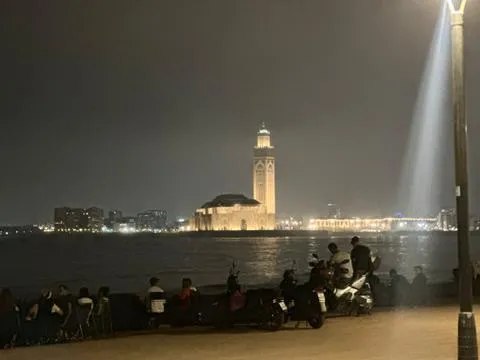
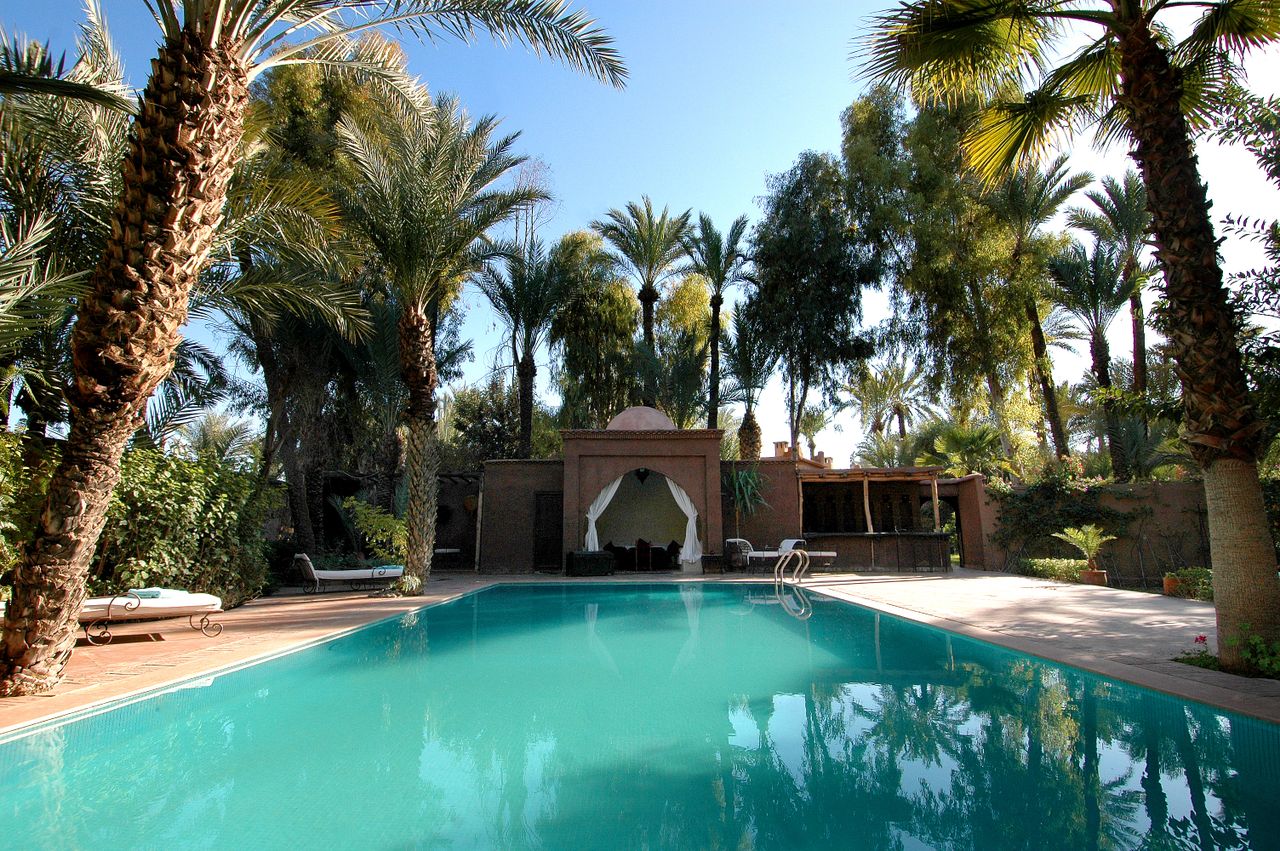
You can buy a villa in Marrakech as a foreigner, and neither Moroccan citizenship nor residency is required.
Before you commit, however, the land title, the seller’s authority, the plot boundaries, the approved plans and the payment route all need independent verification.
A villa also carries checks that an apartment purchase rarely involves, because you are buying land, buildings and permissions together.
Buying a villa in Marrakech at a glance
Five things that decide whether a villa purchase runs smoothly.
- Point 1
Your passport is not the obstacle
Foreign buyers can own villas in urban and residential areas of Marrakech.
- Point 2
The land classification matters
Agricultural land outside urban perimeters is restricted and needs separate legal review.
- Point 3
Land and buildings are separate questions
A clean title says nothing about whether the pool or extension was ever approved.
- Point 4
No single professional covers everything
Legal review, technical inspection and boundary checks come from different people.
- Point 5
Your payment records outlive the purchase
Traceable transfers create the proof that matters years later at resale.
Can a foreigner buy a villa in Marrakech?
Moroccan property rules do not reserve residential housing for Moroccan nationals.
A foreign buyer can therefore purchase a villa in the city’s urban and residential areas.
No prior government permission is normally required for that type of property.
Buying also does not grant you a residence permit, since immigration follows an entirely separate process.
The main legal restriction concerns agricultural land situated outside urban perimeters.
Because some villas sit on larger plots toward the edge of the city, the land classification deserves early attention.
Ask your notary in writing whether the plot sits inside or outside the urban perimeter.
Our wider guide on buying property in Marrakech as a foreigner explains the general process behind these steps.
How is a villa different from an apartment purchase?
An apartment purchase often focuses on the unit, the shared building and the co ownership records.
A villa adds separate questions about the plot, the boundaries, the access, the buildings and the permissions.
Each of those elements can carry its own issue, and they do not always match each other.
For example, the title may be clean while a later extension never appeared in the approved plans.
Boundaries also matter more, because a wall on the ground can sit somewhere other than the recorded line.
Running costs usually rise too, since gardens, pools and larger systems need constant attention.
None of this makes a villa a poor purchase.
Instead, it means your checks should be built around the specific property in front of you.
How should you search for a villa in Marrakech?
A listing shows marketing information rather than verified due diligence.
Photographs, stated areas and descriptions come from the seller side, not from an independent check.
Therefore, ask a short set of questions before you travel for a viewing or become emotionally committed.
- Is the seller the registered owner?
- Is the villa clearly titled?
- What are the recorded plot and built areas?
- Do the pool, extensions and outbuildings appear in the relevant plans?
- Is the villa standalone or inside a managed residence?
- Which services and charges apply?
- What is included in the asking price?
- Who represents the seller?
- Who would receive any proposed deposit?
- What agency commission applies, and who pays it?
- Are recent utility and maintenance records available?
Verbal answers still need confirmation through your notary and the relevant documents.
Our guide on how to find property for sale in Marrakech explains the practical search methods.
Where should you look for a villa in Marrakech?
Villas in Marrakech sit in very different settings, from established residential districts to areas further out along the main roads.
Some are standalone properties on their own plot.
Others sit inside managed residences with shared arrangements.
Neither format is automatically better, because the right choice depends on how you plan to use the villa.
Standalone villa or villa inside a managed residence
| Standalone villa | Villa in a managed residence |
|---|---|
| You control the plot, the walls and every decision on it. | Shared rules may limit changes, rentals or building work. |
| You arrange your own security, gardening and pool care. | Some services may be handled collectively, so confirm which ones actually are. |
| A standalone villa may still carry private road, security, association or shared service costs. | Charges may apply, so request the current figures rather than assuming them. |
| Access roads and utilities need individual verification. | Ask how roads, water, power and waste water are managed in practice. |
| Boundaries and legal access deserve close attention. | Residence rules and management quality deserve close attention. |
Where a residence or association exists, request the documents that show how it really operates.
- Current residence rules.
- Current service information, including which services are actually managed.
- Recent charge statements.
- Any available management accounts.
- Information about unpaid charges affecting the property.
How should you compare an area before you commit?
Rather than ranking districts against each other, test each option against your own daily routine.
First, drive the route you would actually take, at the hours you would actually travel.
Next, check how far you are from shops, clinics, schools and the airport.
Then visit in the evening, because a quiet road can behave differently after dark.
Also ask about water supply, power reliability and how waste water is handled in that area.
Finally, consider who would buy the villa from you later.
Our overview of the best neighborhoods in Marrakech for expats and foreign buyers helps you narrow the shortlist.
What is the safest order for buying a villa?
Most avoidable problems come from doing the right checks in the wrong order.
The safest sequence for a Marrakech villa purchase
The exact process varies by property, so confirm your own sequence with your notary.
- Stage 1
Set the use and the full budget
Include purchase costs, repairs and the first year of running the villa.
- Stage 2
Test the area and the asking price
Visit at different hours and check the price against real comparisons.
- Stage 3
Appoint your own notary
Bring the notary in before you make an offer, not after.
- Stage 4
Verify title, seller and access
Ask your notary to obtain a current ownership record before you sign or pay.
- Stage 5
Compare plans against the building
A qualified architect checks what stands on the plot today.
- Stage 6
Inspect structure, pool and utilities
Technical review reveals the repair costs you would inherit.
- Stage 7
Review terms, then pay and complete
Your notary handles the registration formalities while you keep every record.
Each stage below explains what that step actually involves.
How do you verify the land and the title?
The land record is the foundation of the whole purchase.
Ask your notary to obtain a current ownership certificate rather than accepting a document from the seller.
A screenshot, photocopy or older certificate is not enough to confirm the current legal position.
Morocco’s land registry agency runs an official online property certificate service that your notary can use.
Clearly registered property is generally easier for a foreign buyer to verify, transfer, finance and resell later.
What should your legal due diligence verify?
Some of this appears in the ownership record, while other points require additional documents or professional checks.
- The current ownership record for the property.
- Seller identification, matched against that record.
- Co owners, and heirs where relevant.
- Mortgages, liens and registered restrictions.
- Any power of attorney in use, and exactly what it authorizes.
- Legal access to the villa, including easements affecting the plot.
- The cadastral information and the recorded plot description.
- Other documents relevant to the specific villa.
Your notary or a qualified Moroccan lawyer should tell you which documents apply to your case.
Our step by step guide on how to verify a title deed before buying in Morocco shows what a proper check involves.
If you already have a villa in mind, a short conversation can help you identify which documents may still need to be requested or verified.
We can talk through the property, the asking price, the Marrakech location, your intended use, your budget and your buying stage.
This call is an initial conversation rather than legal, technical, tax, banking or financial advice.
Do the approved plans match the villa you saw?
This question separates a straightforward villa purchase from a difficult one.
Ask for the construction and planning permissions along with the approved plans.
Then compare the built area shown in those documents against the area recorded on site.
Differences often appear where a previous owner added something after the original build.
- Extensions to the main house or an added floor.
- A guest house, staff room or pool house.
- Covered terraces, pergolas and enclosed verandas.
- Boundary walls placed outside the recorded line.
- A pool, technical room or garage added later.
- Converted garages or rooms with a changed use.
Any mismatch between the approved documents and the existing villa can affect the transaction or future use.
Its practical effect must therefore be checked for that specific property rather than assumed.
Ask a qualified architect to compare the plans against the building before you sign anything.
Also confirm the zoning, the permissions and the permitted use with the relevant Marrakech authority or municipality.
Which physical checks does a villa need?
A notary reviews documents, not walls, roofs or pumps.
A separate technical inspection therefore protects you from costs a legal check cannot see.
Structure, roof and drainage
- Cracks in walls, terraces and structural elements.
- Damp, rising moisture and staining around bathrooms or roof edges.
- Roof condition, waterproofing and terrace drainage.
- Ground drainage around the plot after heavy rain.
- Sun exposure, insulation and how the villa handles summer heat.
Pool, water, power and waste water
- Pool structure, lining, leaks, pumps and filtration equipment.
- Water supply source and pressure at different times of day.
- Storage tanks, pumps and any backup arrangement.
- Electrical capacity for pool equipment, air conditioning and pumps.
- Sewage connection, or a septic arrangement and how it is maintained.
- Internet availability if you plan to work from the villa.
- Parking, gates, lighting and security arrangements.
Ask the seller how often the pool and garden are serviced, and by whom.
Meanwhile, request recent utility bills so you can see real consumption rather than an estimate.

Which professional examines which question?
Legal review compared with technical review
These two reviews answer different questions, so a villa buyer usually needs both.
-
Legal review: notary or qualified lawyer
- Who legally owns the land and the buildings.
- Whether the seller has authority to sell.
- Mortgages, liens, heirs and restrictions.
- Legal access, easements and the recorded plot.
- Contract wording, deposit terms and deadlines.
-
Technical review: architect, engineer or surveyor
- Whether the building matches the approved plans.
- Structural condition, cracks and roof integrity.
- Pool shell, equipment and water tightness.
- Physical boundaries against the recorded plot.
- Repair costs you would inherit at completion.
The relevant Marrakech authority or municipality confirms planning status, permissions and permitted use.
Your Moroccan bank, together with Office des Changes guidance, covers the payment route and currency records.
A technical inspection describes the building, yet it does not by itself prove planning compliance.
Equally, an architect or engineer does not confirm who legally owns the property.
I am Anis Chity, a Moroccan based in Marrakech, and I have personally bought four properties in the city.
That experience taught me that the property itself is only part of the decision.
The documents, deposit terms, notary checks, total costs and payment records also deserve careful attention.
For a villa, I would add the plans and boundaries to that list before anything is signed.
How should you judge the asking price?
Villa pricing in Marrakech varies by plot size, build quality, location and condition.
An asking price tells you what the seller hopes for, not what the property is worth.
Instead, gather comparable sales, ask a qualified valuer and factor in the repairs you found.
Renovation, pool work and garden restoration can change the real cost significantly.
Our guide to property valuation in Marrakech explains how to approach a fair price.
If you are also weighing a build instead of a purchase, read our guide on buying land to build a villa in Marrakech.

What should you agree before paying a deposit?
Paying a deposit is a legal step, not an administrative formality.
An offer, a reservation agreement and a promise of sale can carry very different effects.
Refundability depends on the agreement, the facts and applicable law.
Consequently, nobody can promise in advance that a deposit will come back.
- Who receives the money, and in whose account it sits.
- Why the payment is required at this stage.
- Which villa it concerns, described in official terms.
- Under which conditions it is refunded, and under which conditions it is kept.
- What happens if the title or seller checks fail.
- What happens if the inspection reveals a serious defect.
- What happens if the seller withdraws or financing falls through.
- Which deadlines apply to each side.
- Whether the written description matches the villa you visited.
Have your notary or a qualified Moroccan lawyer read the wording before you sign or pay.
Our guide to property deposits in Morocco for foreign buyers sets out these checks in detail.
How should you pay and what records should you keep?
Traceable bank transfers create evidence of payment and of the foreign currency brought into Morocco.
Confirm the receiving account independently, using trusted contact details from your notary or bank.
Follow the payment route confirmed in writing by both of them.
Morocco’s foreign exchange authority explains that foreign investments financed in foreign currency benefit from a convertibility regime covering transfers of income and sale proceeds.
Properly documented funding may therefore support a future transfer, subject to current rules and your own records.
Nobody can guarantee that outcome, so confirm your position with your bank, your notary and the Office des Changes.
Ask whether a convertible dirham account suits your situation before the money moves.
Our explanation of the convertible dirham account for foreign property buyers covers how it is normally used.
- Bank statements showing the funds leaving your account abroad.
- SWIFT confirmations and transfer receipts for every payment.
- Evidence of where the money came from.
- Currency conversion records with the rate and date applied.
- The preliminary agreement, the final deed and all notary receipts.
- The updated property record or certificate confirming ownership, as identified by your notary or ANCFCC.
What costs should you budget beyond the price?
A villa carries purchase costs and ongoing costs, and the second group surprises more buyers.
| At purchase | After you own it |
|---|---|
| Notary work and deed preparation | Pool servicing and equipment repairs |
| Registration duty on the transfer | Garden maintenance and water use |
| Land registry charges | Security, gate and lighting costs |
| Agency commission where applicable | Residence or management charges where applicable |
| Bank charges and currency conversion | Insurance and utility accounts |
| Valuation, survey and architect review | Property management if you are away |
| Renovation and furnishing at the start | Ongoing repairs and seasonal upkeep |
Rates and duties can change, so ask your notary for a current written estimate based on the actual transaction.
Our breakdown of Morocco property purchase costs and notary fees explains how the main items fit together.
You can also confirm the name of any notary through the directory published by the Moroccan notaries council.

What if you plan to rent the villa out?
Rental use is possible for many owners, yet nothing about it is automatic.
Check the residence rules first, because some managed communities restrict short term letting.
Next, confirm the current registration and licensing requirements with the relevant local authority.
Also budget for cleaning, laundry, pool care, garden work and a manager on the ground.
Rental demand can vary by season, location, villa type and target guest, so projections should use cautious assumptions.
Finally, confirm the tax treatment of rental income with a qualified Moroccan tax adviser.
Should you proceed, pause, or walk away?
Some situations call for a decision rather than another round of negotiation.
Where does your villa stand right now?
Use this to place the property honestly before you commit money.
- Proceed
The checks line up
Your notary confirms the owner, the plans match the building, and the terms are written down.
- Pause
Something is unverified
A document is missing, an extension is unexplained, or a boundary looks different from the record.
- Pause
You are being rushed
Pressure to decide today usually means you have not been given time to check.
- Walk away
Verification is refused
If nobody will let you check the documents, the villa is not the problem.
- Walk away
Payment is asked outside the deed
Requests for cash or informal payments deserve a firm stop.
Walking away can simply be the safer choice when serious questions remain open.

Common shortcuts and safer alternatives
| Riskier approach | Safer approach |
|---|---|
| Paying a deposit to secure the villa quickly | Paying once the relevant legal checks, written deposit terms and essential technical or planning conditions have been reviewed with your notary or lawyer |
| Accepting a photo of the title document | Requesting a current certificate from the land registry |
| Trusting a verbal answer about an extension | Comparing approved plans against the building on site |
| Assuming the walls mark the legal boundary | Checking the recorded plot against the physical limits |
| Skipping the inspection because the villa looks new | Arranging an independent technical review before signing |
| Sending money before independently confirming the recipient, account details, purpose and written payment terms | Using the payment route confirmed in writing by your notary and your bank |
| Using only the seller’s recommended notary | Appointing your own notary or independent lawyer |
Questions foreign buyers ask about Marrakech villas
Can a foreigner buy a villa in Marrakech without residency?
Yes, a residence permit is not required to buy a residential villa in Marrakech.
Buying property also does not create an automatic right to live in Morocco.
Residency follows a separate application, so confirm the current conditions with the relevant Moroccan authority.
Do I need to be in Morocco to complete the purchase?
Not always, because part of the process can sometimes be handled through a power of attorney.
However, the notary decides the exact wording and format that will be accepted.
Keep any power of attorney narrow by naming the property, limiting the powers and setting an end date.
Is a pool or extension a problem if it does not appear in the approved plans?
It depends on the property, the local planning position and the documents on file.
Nobody can answer that question from a photograph or a listing description.
Ask a qualified architect to compare the plans with the building, then confirm the position with the relevant authority.
Should I use the notary suggested by the seller or the agent?
You are free to appoint your own notary instead.
Choosing independently keeps the document review separate from the people selling to you.
A qualified Moroccan lawyer can also review the contract from your side.
How much should I budget above the asking price?
The total depends on the property, the transaction and the professionals you use.
Rather than working from a general figure, ask your notary for a written estimate.
Then add your inspection, renovation, furnishing and first year running costs.
What should you verify before committing?
- Confirm the land classification and the title type.
- Obtain a current ownership record through your own notary.
- Match the registered owner against the seller’s identity document.
- Identify co owners, heirs, mortgages and registered restrictions.
- Verify legal access and the road serving the villa.
- Compare the recorded plot and built area with the property on site.
- Review permissions for extensions, pools, terraces and outbuildings.
- Arrange an independent structural and technical inspection.
- Test water pressure, power capacity and waste water arrangements.
- Request pool and garden servicing history with recent utility bills.
- Read every deposit and contract term before signing.
- Agree the payment route in writing and keep every record.
- Request a written estimate of purchase and running costs.
What is the safest next step?
The strongest position you can be in is knowing exactly which questions still need a professional answer.
Gather your notes on the villa, the seller, the documents, the inspection and your payment plan.
Then work through them one by one with the right people.
If you are close to making an offer or paying a reservation fee, this is the moment to slow down.
Book a free 15 minute Morocco Buyer Safety Call to organize your questions and identify what still needs verification.
The call does not replace your notary, lawyer, architect, surveyor, bank, tax adviser or a technical inspection.

Anis is the founder of Buy Property Morocco, a research-based resource created to help foreign buyers understand the real process of buying property in Morocco safely.
He focuses on the practical details most buyers only discover too late: title deed checks, notary steps, compromis de vente risks, transfer taxes, foreign banking rules, repatriating money after a sale, and avoiding common mistakes when dealing with agents or sellers.
Anis has personally bought 4 properties in Morocco and shares practical guidance based on real experience, not theory.
If you are seriously considering buying property in Morocco and want private guidance before you send money, pay a deposit, or sign anything, you can book a buyer safety call here: