
Last updated: 2026. Costs are estimates that move with the market, the dirham, and the finish you choose. Always confirm current figures locally before you commit money.
In 2026, building a villa in Marrakech can cost from about €150,000 for a modest project to €600,000 or more for a premium villa. Luxury projects with prime land can exceed €1 million.
That full range depends on the land, the location, and the finish level you choose.
However, most foreigners go over budget by 30 to 50 percent. The reason is simple. They do not understand how the Moroccan construction system actually works before they start.
This guide gives you the real 2026 numbers, the real risks, and the safe step by step process that protects your money from day one.
At a Glance: Building a Villa in Marrakech in 2026
- Construction only: roughly 4,000 to 12,000 MAD per m² (about €360 to €1,090) depending on finish level
- Full build cost including land: from about €150,000 for a modest project to €600,000 or more for a premium villa, and over €1 million for luxury builds on prime land
- Land prices: 300 to 4,000 MAD per m² depending on the zone (rural outskirts versus Palmeraie)
- Architect fees: usually 5 to 10 percent of the construction cost, and an architect is generally required for a villa
- Permits, notary, and registration: plan for roughly 6 to 10 percent on top of the land price
- Timeline: plan for 18 to 36 months from land purchase to move in, not 12
- Biggest risk: buying land without a clean Titre Foncier (registered title deed), which can create serious legal and resale problems
Construction only versus full project cost
These two numbers are very different, so keep them separate in your budget.
Construction only means the building works alone, from the structure to the finishing.
Full project cost means everything else as well.
That includes the land, notary, registration, architect, permits, the pool, boundary walls, landscaping, utility connections, furniture if relevant, and a contingency buffer.
Most foreigners compare construction prices but forget the full project cost. As a result, the final bill arrives much higher than expected.
Already considering a property?
See the 14 Day Buyer Plan: $299 →
Get 14 days of personal buyer support, three private calls and WhatsApp support.
Get help reviewing up to three properties before you commit money.
How does building a villa in Marrakech actually work?
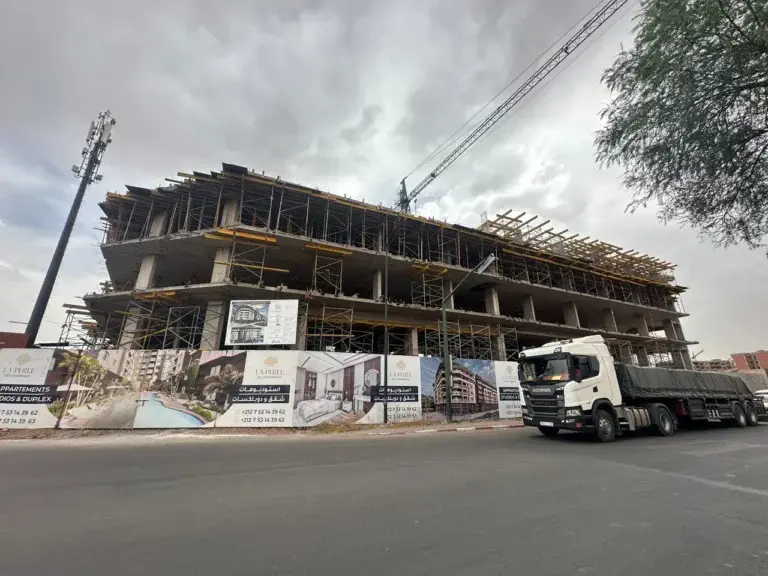
Morocco does not work like Spain, France, or the UK when it comes to construction.
There is no simple build and sell turnkey system for foreigners who want something custom.
Instead, you buy land, hire a licensed Moroccan architect, get a permis de construire (building permit), and manage a local contractor.
Every step requires paperwork filed with the local authorities in Marrakech.
For a villa, an architect registered with the Ordre National des Architectes is generally required. Confirm the exact rule for your plot with your architect and the commune.
The permit process goes through the Commune Urbaine de Marrakech, or the relevant rural commune if you build outside the city.
Also important, rural land outside the urban perimeter has very different rules about what you can build.
Many foreigners only discover this after they have already paid for the land.
What about turnkey villa construction in Marrakech?
You may hear builders or agents offer a villa clé en main, which means a turnkey villa.
On paper, this sounds simple. You pay one price, and the builder delivers the finished property.
In reality, you still need to check the details carefully, because turnkey does not always mean everything is included.
Before you accept any turnkey villa offer in Marrakech, ask for a written list that confirms whether the price includes:
- The land purchase and title transfer
- Architect plans and permit submission
- The building permit
- Structure and full finishing
- Kitchen, bathrooms, plumbing, and electrics
- Pool, terraces, boundary walls, and landscaping
- Water, electricity, sewage, septic, or well connections
- Final inspection and certificate of conformity
- Updating the Titre Foncier after construction
A real turnkey project should be clear about all of this before you pay.
If the contract only says clé en main without listing the exact inclusions, exclusions, deadlines, payment stages, and penalties for delay, you are not protected enough.
Why do villa build prices online differ so much?
You will see wildly different prices online for the same size villa.
The reason is that two quotes are almost never measuring the same thing.
For example, one builder quotes only the bare structure, while another quotes a fully finished home.
Therefore, before you compare any two numbers, you need to know what each one actually includes.
| What the quote covers | What it usually includes | What it often excludes |
|---|---|---|
| Gros œuvre only | Foundations, structure, walls, roof slab, basic blockwork | All finishing, plumbing fixtures, electrics, tiles, kitchen, paint |
| Basic finishing | Structure plus simple finishing, standard tiles, basic fittings | Pool, landscaping, boundary walls, premium materials |
| Luxury finishing | High end materials, bespoke joinery, designer fittings | Still may exclude pool, garden, utilities, and permits |
Many quotes also leave out the pool, landscaping, boundary walls, utility connections, permits, architect fees, land taxes, and contingency.
As a result, a low price per square meter often hides tens of thousands of euros in costs that arrive later.
How much does construction cost per square meter in Marrakech in 2026?
The cost to build varies a lot based on finish quality, the materials you source, and how well you supervise the work.
The table below shows realistic 2026 ranges by build level.
| Build level | Cost per m² (MAD) | Cost per m² (EUR approx.) |
|---|---|---|
| Gros œuvre only (structure, no finishing) | 2,500 to 4,000 | €230 to €360 |
| Basic finished villa | 4,000 to 5,500 | €360 to €500 |
| Standard finished villa | 5,500 to 8,000 | €500 to €730 |
| Premium villa | 8,000 to 12,000 | €730 to €1,090 |
| Luxury or bespoke villa | 12,000 to 20,000 or more | €1,090 to €1,820 or more |
Estimates for 2026. Exchange rate used is approximately 11 MAD to 1 EUR. Rates change, so confirm current figures before budgeting.
Full project budget examples for 2026
Construction cost is only one part of the budget.
To plan properly, you need the full project cost, which includes land, construction, and the extra costs most quotes leave out.
The examples below are illustrative, not fixed quotes. They show how the pieces add up.
| Villa type | Built area | Land assumption | Construction cost | Extra costs | Full estimated budget |
|---|---|---|---|---|---|
| Small standard villa | 150 m² | 500 m² at 900 MAD/m² | ~900,000 MAD | ~400,000 MAD | ~1,750,000 MAD (€159,000) |
| Mid range family villa | 250 m² | 1,000 m² at 800 MAD/m² | ~1,750,000 MAD | ~600,000 MAD | ~3,150,000 MAD (€286,000) |
| Premium villa | 350 m² | 1,500 m² at 1,200 MAD/m² | ~3,500,000 MAD | ~1,000,000 MAD | ~6,300,000 MAD (€573,000) |
| Luxury villa | 450 m² | 2,500 m² at 2,000 MAD/m² | ~6,750,000 MAD | ~2,000,000 MAD | ~13,750,000 MAD (€1,250,000) |
Extra costs cover items such as notary and registration, architect fees, the building permit, the pool, landscaping, boundary walls, utility connections, and a contingency buffer. These are realistic mid range examples, not guaranteed prices.
How much does it cost to build a 3, 4, or 5 bedroom villa in Marrakech?
Many buyers do not think in square meters at first.
They think in bedrooms, lifestyle, guest space, and whether the villa can work for family use or short term rental.
The table below gives practical 2026 examples for a 3 bedroom, 4 bedroom, or 5 bedroom villa in Marrakech.
| Villa size | Typical built area | Likely buyer profile | Realistic full project budget |
|---|---|---|---|
| 3 bedroom villa | 150 to 200 m² | Couple, small family, or simple rental villa | About €150,000 to €280,000 depending on land and finish |
| 4 bedroom villa | 220 to 300 m² | Family villa or stronger Airbnb style property | About €250,000 to €450,000 depending on location and extras |
| 5 bedroom premium villa | 350 m² or more | Luxury family home, retreat, or high end rental project | About €500,000 and above, especially with a pool and prime land |
These are full project examples, not construction only prices.
That means the numbers should include land, construction, architect, permit, notary and registration, utility connections, pool if planned, boundary walls, landscaping, and a contingency buffer.
Marrakech areas compared for building a villa

Land is the most variable cost and the one most foreigners underestimate in complexity.
The table below compares popular areas by price level, who they suit, and the main risk to watch.
| Area | Price level | Who it suits | Main risk |
|---|---|---|---|
| La Palmeraie | High, 1,500 to 4,000 MAD/m² | Buyers wanting prestige and large plots | Strict zoning rules can limit height, footprint, and materials |
| Route de l’Ourika | Mid, 300 to 900 MAD/m² | Buyers wanting views and Atlas mountain access | Rural zoning and agricultural classification need careful checks |
| Route d’Amizmiz | Lower, 250 to 800 MAD/m² | Buyers wanting quiet and lower land cost | Distance from the city, utilities, and agricultural land risk |
| Route de Fès | Mid, 500 to 1,200 MAD/m² | Buyers wanting a developing zone at lower cost | Longer drive to the medina, infrastructure still maturing |
| Agdal | High, 2,000 to 5,500 MAD/m² | Buyers wanting a central, established area | Dense urban fabric, large plots are hard to find |
| Hivernage | High, premium urban | Buyers wanting a central prestige address | Very limited land, mostly built up already |
| Tameslouht | Low, 150 to 500 MAD/m² | Buyers chasing the cheapest land | Agricultural classification can block construction entirely |
| Golf zones (Amelkis, Al Maaden area) | High, premium | Buyers wanting resort style living | Service charges and development rules tied to the golf estate |
Prices reflect market observations for 2026 and vary by exact plot. Confirm any figure with local checks before you commit.
Is it cheaper to build or buy a villa in Marrakech?
Building can be cheaper than buying an already finished villa, but only when the land, permits, contractor, and timeline are controlled properly.
If you buy the right plot at the right price and supervise the build well, you may create a villa for less than the price of a similar finished property.
However, that saving comes with more risk.
You have to deal with land checks, zoning, permits, architect fees, contractor quotes, utility connections, delays, and unexpected costs.
| Option | Main advantage | Main risk | Who it suits |
|---|---|---|---|
| Build a villa | More control over design, layout, finish, and long term value | Land, permit, contractor, delay, and budget risk | Buyers with patience, strong due diligence, and local supervision |
| Buy an existing villa | Faster, easier to inspect, and more predictable | You may pay a premium for someone else’s finished project | Buyers who want speed, certainty, or rental income sooner |
| Buy and renovate | Possible value if the structure is good and the price is right | Hidden structural, permit, and repair issues | Buyers who can inspect properly and manage works locally |
My practical view is simple.
If you are outside Morocco and cannot supervise the process, buying an existing villa can be safer.
If you live in Morocco, have a trusted architect, a good notary, and independent project supervision, building can make more sense.
Planning a villa build? Read the full Morocco house building cost guide first
If you are thinking about building a villa in Morocco, the villa price alone is not the full story.
From what I have seen in the Moroccan property market, the biggest mistakes usually happen before construction even starts.
People focus on the design, the pool, the finish, and the dream lifestyle. However, they do not always look closely enough at the land, permits, title situation, contractor payments, utilities, and hidden costs.
This is why I also created a separate guide on the cost of building a house in Morocco. That article gives the wider picture for anyone trying to understand construction costs in Morocco before committing serious money.
So before you compare only the cost per square meter, read the full building cost guide first.
What must you check before buying land?
Most expensive villa mistakes are land mistakes.
Therefore, you should treat the land checks below as non negotiable before you pay any deposit.
- Titre Foncier. Confirm the plot has a registered title at the ANCFCC. If it is only Melkia and not a Titre Foncier, the risk rises sharply.
- Zoning. Confirm the land is zoned for residential construction, not agriculture.
- Plan d’aménagement. Check the local urban plan to see what is allowed on the plot.
- Note de renseignement urbanistique. Where available, request this document from the commune. It states the planning rules that apply to the specific plot.
- Agricultural land risk. Very cheap land is often agricultural. In most cases it cannot be built on, especially by foreign buyers.
- Access road. Confirm there is legal road access. Landlocked plots are a common trap.
- Electricity and water. Check the real distance to the nearest connection. Long connections cost more and take longer.
- Sewage or septic. Many plots have no mains sewage, so you may need a fosse septique (septic tank) with its own permit.
- Building permit realism. Ask the commune directly whether a permis de construire is realistic for this plot. Do not rely on a seller saying it is possible.
Already considering a property?
See the 14 Day Buyer Plan: $299 →
Get 14 days of personal buyer support, three private calls and WhatsApp support.
Get help reviewing up to three properties before you commit money.
Step by step: how to build a villa in Marrakech

- Verify the land title (Titre Foncier). Check that the plot is registered at the ANCFCC. If it is not registered, be very cautious, because the legal process can take years.
- Check zoning (plan d’aménagement). Confirm at the local commune that the land is zoned for residential construction. Agricultural land cannot normally be built on without reclassification, which is rarely approved for foreigners.
- Hire a licensed Moroccan architect. For a villa, this is generally required. The architect submits the plans to the commune and signs off on the phases.
- Purchase through a Moroccan notary. A notary handles the funds and registers the sale. Never pay a seller directly without a notary involved.
- Transfer funds through official banking channels. As a foreigner, transfer from abroad through a Moroccan bank. This creates a compte en dirhams convertibles record, which matters when you later want to repatriate money. Your Moroccan bank handles the banking side, while foreign exchange and repatriation rules should be checked with the Office des Changes, your bank, and your notary. For context, Bank Al-Maghrib is the central bank.
- Apply for the permis de construire. Your architect handles this. Allow a few months, and longer in rural areas near Marrakech.
- Select and contract a builder. Get at least three written quotes. Have your architect review them. Avoid large upfront payments.
- Supervise construction in phases. If you are not based in Morocco, hire an independent project manager who is separate from the contractor.
- Final inspection and certificate of conformity. This is needed before you can legally occupy or connect utilities.
- Register the built property. Update the Titre Foncier to reflect the finished building. Foreigners often skip this, and it causes major problems on resale.
Can foreigners finance a villa build in Morocco?
Some foreign buyers ask whether they can get a mortgage or construction loan to build a villa in Morocco.
The answer depends on your profile, your residency situation, your income, the bank, the land title, and whether the project is considered acceptable security.
Some Moroccan banks may consider financing for non residents or foreign buyers, but the conditions are usually stricter than for a local salaried buyer.
You should expect the bank to ask for documents such as:
- Passport and identity documents
- Proof of income
- Bank statements
- Tax documents from your country of residence
- Proof of savings or deposit
- Details of the land and Titre Foncier
- Architect plans and construction budget
- Permit status or proof that the project can legally be built
Many foreign buyers still self fund the land purchase and construction in stages, because construction finance can be slower and more complicated.
If you plan to use bank finance, speak to the bank before you pay a deposit on land.
The last thing you want is to buy a plot and only later discover that the bank will not finance that type of land or construction project.
What must be included in a contractor quote?
A verbal quote means nothing in Morocco.
Instead, insist on a written quote that lists every part of the build, so nothing can be added as a surprise later.
A complete quote should clearly state who pays for each of these items:
- Structure and foundations
- Waterproofing
- Plumbing
- Electricity
- Tiles and flooring
- Windows and doors
- Kitchen
- Bathrooms
- Painting
- Pool
- Landscaping
- Boundary walls
- Utility connections for water, electricity, and sewage
If any line is missing, ask whether it is included or excluded, and get the answer in writing.
Payment schedule risk: protect your money during the build
The most painful villa stories almost always involve money paid too early.
Because of this, the payment schedule matters as much as the price.
A large upfront payment removes your leverage. Once the builder holds most of the money, you have little protection if the work slows or stops.
Instead, tie payments to verified progress. For example, release money in stages after each phase is checked, ideally by your architect or independent project manager.
The biggest mistakes foreigners make when building in Marrakech
These mistakes are common, but they are avoidable when you know about them in advance.
- Buying land without checking the Titre Foncier. Melkia land looks cheap because it is risky. Disputes can take many years to resolve.
- Paying a large deposit before a notary is involved. Informal reservation fees often have nothing legally binding behind them. If the deal falls apart, recovering the money can be very hard.
- Trusting a verbal quote. Every stage of the build should sit in a signed written contract.
- Ignoring zone restrictions in La Palmeraie. Construction density, height, and materials can be restricted. Some plans simply cannot be approved.
- Using a contractor recommended only by your agent. Undisclosed commissions are common, so get independent options too.
- Skipping the independent project manager. If you visit the build only twice a year, corners can be cut.
- Bringing money in informally. Without official transfer records, you may be unable to repatriate profits when you sell.
Hidden risks nobody tells you about
Fake or disputed title deeds
Morocco has two parallel land systems, the official Titre Foncier and the older traditional system.
Only a Titre Foncier gives you a clearly registered title.
Some sellers present official looking documents that are not a Titre Foncier.
Therefore, always verify directly with the ANCFCC before signing anything.
Agricultural land traps
Land marked as agricultural is very cheap.
Sellers sometimes claim permission to build can be obtained.
In most cases it cannot, especially for foreign buyers.
As a result, you can end up owning land you cannot legally build on.
Water and septic issues
Much of the land south and east of Marrakech has no mains sewage.
Because of this, you may need a septic tank and a connection to ONEE, or a well.
Both require permits. Both add cost. Neither is instant.
Rural connection timelines can run many months.
Inheritance questions for foreign owners
Inheritance rules can be complex for foreign owners in Morocco.
This is an area where advice from a bilingual Moroccan lawyer is essential before you buy, not after.
The Barreau de Rabat lists registered Moroccan lawyers if you need to verify credentials.
Agent and listing risk
Morocco does not regulate the real estate agent profession the way much of Europe does.
Almost anyone can call themselves an agent.
Listings are sometimes inaccurate or significantly misrepresented.
The price you see online is rarely the price the owner truly expects.
What I learned buying property in Marrakech
I am Anis Chity, based in Marrakech. I have personally bought 4 properties in Morocco, and I created Buy Property Morocco to help foreign buyers avoid the mistakes I had to learn the hard way.
Deals fall apart more often than people expect.
Before my successful purchase, several deals collapsed. One owner changed her mind. Another kept changing what was included until I walked away.
The lesson is simple. Do not get emotionally attached, or pay anything, before the paperwork is real.
Informal deposits are risky, even when they work out.
On one deal, the seller was abroad, so I paid a small guarantee deposit informally until he returned.
It worked out, but I would not do it that way again. Today I treat it as a warning. Deposits should go through the notary, or come with clear written proof.
For a villa, the same discipline matters even more. You are dealing with land, zoning, permits, and larger sums.
So verify the title, check the zoning at the commune, and keep every payment inside the notary process. The paperwork is what protects you, not trust alone.
Taxes, fees, and costs foreigners often miss

| Cost item | Typical level | Notes |
|---|---|---|
| Registration tax (Droits d’Enregistrement) | Around 4 percent of the price | Paid at land purchase through the notary. Confirm the current rate. |
| Conservation Foncière fee | Around 1 percent of value | Paid to the ANCFCC for registering ownership. |
| Notary fees | Around 1 to 1.5 percent | Largely regulated. Ask for the exact figure in writing. |
| Stamp duty (Timbre fiscal) | Small amounts | Applied to various documents in the process. |
| Capital gains tax on a future sale | Commonly cited near 20 percent of the gain | Rules, minimums, and exemptions vary. Confirm with the DGI or your notary. |
| Annual local property taxes | Varies by rental value | Annual tax on Moroccan real property. |
| Taxe d’Habitation | Possible exemption period on new builds | Ask the commune about any exemption that applies. |
Rates change. Always confirm current figures with the Direction Générale des Impôts (DGI) or your notary.
Who should be on your team before you build?
A villa build in Marrakech is not something you should manage with only an agent and a contractor.
You need the right people around the deal before money moves.
| Person | Why they matter | What to watch |
|---|---|---|
| Notary | Checks the sale, handles funds, and registers the land transfer | Do not pay the seller directly before the notary is involved |
| Architect | Prepares plans, submits permits, and checks technical feasibility | Confirm they are registered and experienced with the commune involved |
| Lawyer | Useful for extra legal review, inheritance issues, and foreign buyer questions | Use someone independent from the agent and seller |
| Project manager | Supervises the site if you are not in Morocco full time | Keep this person independent from the contractor |
| Contractor | Builds the villa according to the plans and contract | Get a written quote, staged payments, and proof of previous work |
| Bank | Handles official transfers, proof of funds, and possible financing | Keep clean transfer records for future resale and repatriation |
The cleaner the team, the safer the project.
If the agent, architect, contractor, and project manager are all connected to each other, you need to be even more careful about conflicts of interest.
How to verify everything safely before you commit
- Check the Titre Foncier number. Every registered plot has one. Ask the seller for it and cross reference at the ANCFCC.
- Hire your own independent bilingual lawyer. Not the one your agent recommends. A separate lawyer who works only for you.
- Get an urban planning check at the commune. Ask the commune directly what is permitted on the specific plot. Bring the Titre Foncier reference.
- Get a topographic survey (levé topographique). This confirms the real boundaries before you buy.
- Confirm contractor registration. Ask for their Registre de Commerce number and check past projects with your architect.
- Insist all money passes through the notary. Deposits, land payments, everything. The notary is your single most important protection.
- Transfer funds officially. Use a bank transfer to your Moroccan account and keep every document. This helps when you later sell and want to repatriate funds. Confirm the current rules with the Office des Changes, your bank, and your notary, and see Bank Al-Maghrib for background on foreign investment.
What most websites will not tell you
The listed land price is usually a starting point
Listed land prices are often set high, especially for foreign buyers.
A well prepared local buyer can frequently negotiate a meaningful discount.
A foreign buyer negotiating alone often achieves less, because sellers assume different price anchors.
The Palmeraie can be hard for new builds
La Palmeraie has legendary status, but its zoning rules can limit what you build.
Height limits, footprint limits, and aesthetic rules are real and enforced.
Other routes can offer more freedom and more land for the same money.
The architect and the contractor may know each other
In a market the size of Marrakech, architects often work with specific contractors.
This is not always a problem, but you should ask directly whether they have a commercial relationship.
An independent project manager is the cleanest solution for a foreign owner.
Build timelines stretch
Contractors often quote optimistic timelines while juggling several projects.
A 12 month build commonly takes 18 to 24 months.
Budget for that in your accommodation, carrying costs, and currency exposure.
The CRI Marrakech can help
Foreign investors can get official guidance from the CRI Marrakech.
It is free, yet most foreigners never use it.
Post build registration is where resale deals stall
When you sell, the Titre Foncier should reflect the actual built structure.
Many foreigners skip updating the title after construction.
Later, on resale, that gap can delay or reduce the sale until it is corrected.
Simple build budget checklist
Use this quick checklist to sanity check any villa budget before you commit money.
- Land price confirmed against the area, not the listing
- Titre Foncier verified at the ANCFCC
- Zoning and plan d’aménagement checked at the commune
- Building permit confirmed as realistic for the plot
- Architect fees included in the budget
- Written contractor quote that lists finishing, not just structure
- Pool, landscaping, and boundary walls priced separately
- Utility connections for water, electricity, and sewage costed
- Notary, registration, and tax costs added
- Contingency buffer of at least 10 to 15 percent set aside
- Payments tied to inspected progress, not paid upfront
- Funds transferred officially through a Moroccan bank
Quick reference: key numbers for a Marrakech villa in 2026
| Item | Range |
|---|---|
| Land cost per m² (mid range zones) | 500 to 1,500 MAD (€45 to €135) |
| Construction per m² (standard finish) | 5,500 to 8,000 MAD (€500 to €730) |
| Architect fees | 5 to 10 percent of construction |
| Notary and registration on land | Around 6 percent of the land price |
| Building permit and admin | 15,000 to 50,000 MAD |
| Pool (basic) | 150,000 to 250,000 MAD |
| Full project, 250 m² villa, 1,000 m² plot | €280,000 to €420,000 (good finish, mid range area) |
| Timeline, land to keys | 18 to 36 months (realistic) |
French and Arabic terms you may hear
You will hear these terms during a villa project in Morocco. A quick reference helps.
prix construction villa Marrakech: villa construction price in Marrakech.
coût construction villa Marrakech: villa construction cost in Marrakech.
permis de construire: building permit.
gros œuvre: the structural shell of the build.
second œuvre: the finishing work after the shell.
finitions: finishes.
titre foncier: registered land title.
note de renseignement urbanistique: planning information note for a plot.
تكلفة بناء فيلا في مراكش: the cost of building a villa in Marrakech.
ثمن بناء فيلا في مراكش: the price of building a villa in Marrakech.
رخصة البناء: building permit.
الرسم العقاري: the land title.
Frequently asked questions
How much does it cost to build a villa in Marrakech?
In 2026, a villa usually costs between €120,000 and €500,000 or more once you include land, construction, and the extra costs most quotes leave out. The final figure depends mostly on the land and the finish level.
How much does construction cost per square meter in Marrakech?
Construction alone runs roughly 4,000 to 12,000 MAD per m², about €360 to €1,090, for basic to premium finishes. Luxury or bespoke work can go well above that.
Is it cheaper to build or buy a villa in Marrakech?
Building can give you more control and value if the land and process go smoothly. However, buying an existing villa is often faster and more predictable. Building carries more risk around land, permits, and contractor management.
How much does land cost near Marrakech?
Land ranges from about 150 to 500 MAD per m² in cheap rural zones, up to 1,500 to 4,000 MAD per m² or more in prime areas like La Palmeraie. Cheaper land often carries agricultural and zoning risk.
Can foreigners buy land and build in Morocco?
In general, foreigners can buy titled urban land and build, subject to zoning and permits. Rural and agricultural land is more restricted. Confirm your specific situation with a notary and the commune before you commit.
Can foreigners build on rural land near Marrakech?
It depends on the classification. Agricultural land usually cannot be built on, and reclassification is rarely approved for foreigners. Always check the zoning and the plan d’aménagement before buying.
How long does it take to build a villa in Marrakech?
Plan for 18 to 36 months from land purchase to move in. Many builds quoted at 12 months take 18 to 24 months in practice.
What does gros œuvre mean in Morocco?
Gros œuvre is the structural shell of the building, including foundations, structure, walls, and roof slab. It does not include finishing, plumbing fixtures, electrics, tiles, or the kitchen.
What is usually excluded from a contractor quote?
Quotes often exclude the pool, landscaping, boundary walls, utility connections, permits, architect fees, and finishing items. Ask for each item in writing so nothing is added later as a surprise.
Do I need an architect to build a villa in Morocco?
For a villa, an architect is generally required, and the architect handles the permit submission. Confirm the exact requirement for your plot with the commune and your architect.
What permits are needed?
The main one is the permis de construire (building permit). You may also need permits for a septic tank and for utility connections. The commune is the right place to confirm what applies to your plot.
How much contingency should I budget?
Set aside at least 10 to 15 percent of the total budget for surprises. Many foreign buyers go over by 30 to 50 percent, so a healthy buffer protects you.
How much does it cost to build a 3 bedroom villa in Marrakech?
A 3 bedroom villa in Marrakech often needs around 150 to 200 m² of built area. As a full project including land and extras, a realistic 2026 budget may be around €150,000 to €280,000 depending on location, finish level, pool, utilities, and land price.
How much does it cost to build a 4 bedroom villa in Marrakech?
A 4 bedroom villa often sits around 220 to 300 m² of built area. As a full project, a realistic 2026 budget may be around €250,000 to €450,000, with higher budgets in premium areas or with luxury finishing.
What does villa clé en main mean in Marrakech?
Villa clé en main means turnkey villa, but you must still check the contract carefully. The price may or may not include the pool, garden, boundary walls, utilities, permits, kitchen, bathrooms, and final title update.
Can foreigners get a construction loan in Morocco?
Some Moroccan banks may consider financing foreign buyers or non residents, but the conditions vary. The bank will usually want income proof, savings, bank statements, clean title, project documents, and a realistic permit path.
Who do I need to build a villa safely in Marrakech?
At minimum, you should have a Moroccan notary, a licensed architect, a written contractor agreement, and ideally an independent project manager if you are not in Morocco full time. A lawyer can also help with extra legal checks.
Already considering a property?
See the 14 Day Buyer Plan: $299 →
Get 14 days of personal buyer support, three private calls and WhatsApp support.
Get help reviewing up to three properties before you commit money.
This article reflects market conditions in 2026 and is practical guidance from someone focused on helping foreign buyers avoid mistakes in Morocco. It is not legal, tax, or financial advice, and it does not replace a notary, lawyer, architect, or official authority. Always do your own due diligence and confirm your exact situation before any purchase. Relevant authorities: ANCFCC, Bank Al-Maghrib, Direction Générale des Impôts, CRI Marrakech.

Anis is the founder of Buy Property Morocco, a research-based resource created to help foreign buyers understand the real process of buying property in Morocco safely.
He focuses on the practical details most buyers only discover too late: title deed checks, notary steps, compromis de vente risks, transfer taxes, foreign banking rules, repatriating money after a sale, and avoiding common mistakes when dealing with agents or sellers.
Anis has personally bought 4 properties in Morocco and shares practical guidance based on real experience, not theory.
If you are seriously considering buying property in Morocco and want private guidance before you send money, pay a deposit, or sign anything, you can book a buyer safety call here: