

Yes, a mortgage in Morocco for foreigners is possible, including for some non resident buyers.
However, approval depends on your residency status, income proof, deposit size, property title, bank valuation, age, debt level, and whether your money enters Morocco through official banking channels.
The biggest mistake I see foreign buyers make is signing a compromis de vente and paying a deposit before the mortgage is protected in writing.
Read this before you speak to any bank, agent, or developer in Morocco.
- Foreigners can apply for home loans in Morocco. Several banks consider foreign residents and non resident buyers, but approval is never automatic.
- Non resident buyers usually need more cash. Many should prepare for 30% to 50% or more in documented funds, plus purchase costs.
- Advertised maximums are not guarantees. Office des Changes rules, published bank products, and your real approval are three different things.
- Rates should be checked directly. Bank Al Maghrib showed an average real estate loan rate of around 5.13% in Q1 2026, and foreign non resident files may price higher.
- Your money must move through the banking system. Keep your foreign currency import proof, and make sure the deed records how the price was paid.
- Most banks want a clean titre foncier. Melkia only property or unregistered medina property can be impossible to finance.
- Never sign a compromis de vente without a financing condition. That clause is called a condition suspensive.
A bank can accept you as a borrower and still refuse the property you fell in love with.
Book a Free 15 Minute Morocco Buyer Call
Tell Anis what you want to buy, your budget and where you are in the process.
Get buyer side clarity on the property, the financing risks and the questions to ask before you pay or sign.
The call is free, lasts 15 minutes, and gives practical buyer guidance rather than mortgage approval, legal advice or financial advice.
Can Foreigners Get a Mortgage in Morocco?
Yes, foreigners can get a mortgage in Morocco, and that includes some non resident buyers living abroad.
However, legal permission to buy is not the same as bank approval.
Instead, the bank studies your income, country of residence, debt level, deposit, age, property title, and its own valuation of the property.
For example, a clean modern apartment with a registered title is far easier to finance than a charming but unregistered riad in the medina.
So the real question is whether your profile and your property are both bankable.
I am Anis Chity, I live in Marrakech, and I have personally bought four properties in Morocco.
All four purchases were paid in cash, so the financing rules on this page come from official sources rather than from a loan of my own.
Everything about mortgages here rests on the Office des Changes framework, Bank Al Maghrib data, and published Moroccan bank products.
My own experience appears only where it genuinely applies, such as price checks, title verification, notary steps, deposits, and money entering Morocco.
If you are also considering construction, read my separate guide on whether foreigners can get loans to build property in Morocco.
The 80%, 70%, and 50% Mortgage Confusion Explained
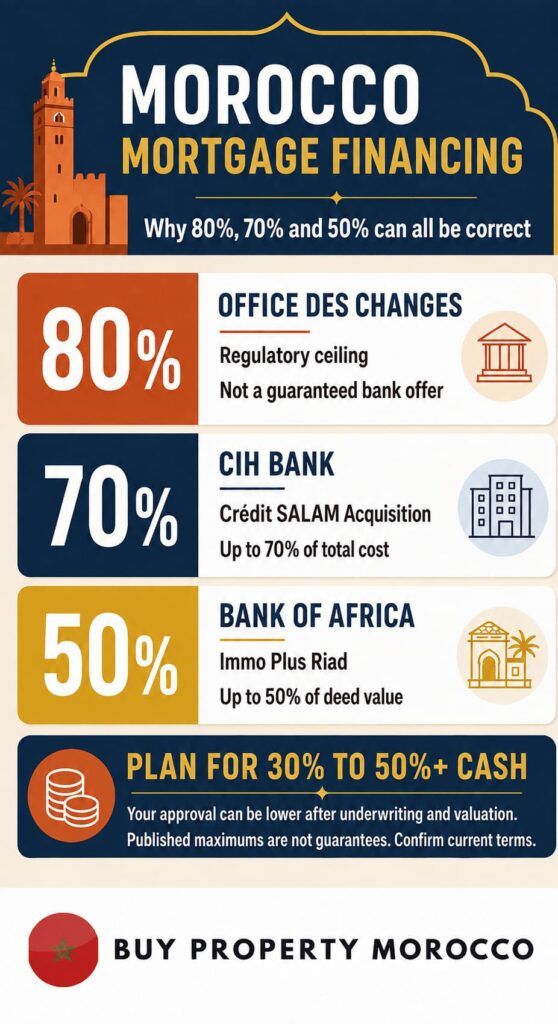
Buyers see one website mention 80%, one bank mention 70%, and another mention 50%.
All three can be true, yet they do not mean the same thing.
| Number | What It Usually Means | Why It Matters |
|---|---|---|
| Up to 80% | Office des Changes regulatory framework for certain compliant non resident property loans. | This is the foreign exchange ceiling, not your guaranteed bank approval. |
| Up to 70% | CIH Bank publishes financing up to 70% of the total cost on Crédit SALAM Acquisition. | This is an advertised product maximum, and eligibility for a foreign non resident applicant must be confirmed with the bank. |
| Up to 50% | Bank of Africa markets Crédit Immo Plus Riad to foreign non residents, covering up to 50% of the deed value. | This is the clearest published limit aimed specifically at foreign non resident buyers. |
| 30% to 50%+ cash | A realistic planning range many foreign non resident buyers should prepare for. | This protects you from valuation gaps, stricter underwriting, and rejected high leverage assumptions. |
What Each Number Really Promises
Importantly, none of those percentages is a decision about you.
The 80% figure is a regulatory ceiling set by the foreign exchange framework, rather than an offer from any bank.
Published product maximums are limits your file still has to earn, and your real approval can land below all of them once income, debts, age, and the valuation are reviewed.
Prepare as if you may need 30% to 50% or more in cash, even where a product advertises a higher maximum.
This matters most if you are buying from abroad, buying a riad, or buying where the title needs extra checks.
Which Value Is the Percentage Based On?
A percentage means very little until you know what it is applied to.
Bank of Africa applies its published maximum to the deed value, while CIH applies its maximum to a total cost figure.
Neither one is automatically the price you agreed with the seller, and the bank accepted valuation can be lower again.
Therefore, ask each bank which number its percentage is calculated on, then repeat the question in writing once you receive a formal offer.
Which Moroccan Banks Lend to Foreign Non Residents?

Several Moroccan banks run international, expat, or non resident banking teams, yet the answer still depends on your nationality, residence country, income file, property type, and branch.
| Bank | Foreign Non Resident Mortgages | Known Product or Angle | What to Verify |
|---|---|---|---|
| Bank of Africa (BMCE) | Published product for this audience | Crédit Immo Plus Riad, marketed to foreign non residents. | Current eligibility, rate type, repayment term, required account, and eligible property type. |
| CIH Bank | Confirm eligibility directly | Published acquisition product, but eligibility for a foreign non resident applicant must be confirmed directly with CIH. | Whether your nationality and residence status qualify, current rate, fees, and product structure. |
| Attijariwafa Bank | Case by case | Large Moroccan bank with international and expat banking presence. | Current loan to value, rate, income documents, and whether your branch handles foreign non resident files. |
| Banque Populaire | Case by case | Strong MRE banking network and convertible dirham account products. | Whether you are treated as MRE, foreign resident, or foreign non resident. |
| BMCI (BNP Paribas) | Case by case | International bank profile may help some European applicants with strong documentation. | Whether your foreign income and documents match current underwriting rules. |
| Crédit du Maroc | Case by case | May consider well documented files depending on branch and property. | Branch policy, income documents, debt ratio, rate, and property eligibility. |
Published Products Versus Case by Case Applications
Bank of Africa publishes the clearest offer aimed specifically at foreign non residents, because its official page names that audience.
CIH publishes an acquisition product with confirmed maximums, yet its page does not establish that every foreign non resident applicant qualifies.
| Published Product | Max Financing | Max Term | Rate Type | Foreign Non Resident Eligibility |
|---|---|---|---|---|
| Bank of Africa, Crédit Immo Plus Riad | Up to 50% of the deed value. | Up to 25 years. | Fixed or variable, both published. | Published for foreign non residents, with a Bank of Africa convertible dirham account required. |
| CIH Bank, Crédit SALAM Acquisition | Up to 70% of the total cost. | Up to 15 years. | Confirm the option available for your file. | Must be confirmed directly with CIH, because the published page does not establish automatic eligibility. |
The Bank of Africa page also states that the application can begin online.
- CIH Bank Crédit SALAM Acquisition for its published acquisition financing terms.
- Bank of Africa Crédit Immo Plus Riad for foreign non resident buyers.
- Office des Changes loans to non residents for the official foreign exchange framework.
- Bank Al Maghrib lending rates for current mortgage interest rate benchmarks.
Speak to at least two or three banks, because the same buyer often gets different answers by branch.
A specialist who understands how to finance property in Morocco as a foreigner can save you time here.
How Much Deposit Do Foreign Buyers Usually Need?
Foreign non resident buyers often need more cash than they expected.
As a working estimate for 2026, prepare for 30% to 50% of the purchase price, and sometimes more.
Why the Required Cash Can Increase
- The bank lends against its own valuation, not the price you agreed with the seller.
- Income, age, debt, or thin documents can push the bank to reduce the loan.
- Financing gets harder for a riad, rural property, or older medina property.
If you agree to pay MAD 2,000,000 and the bank values the property at MAD 1,600,000, the bank uses its valuation.
At 50% loan to value, that gives you a loan of MAD 800,000.
You must then fund the remaining MAD 1,200,000 yourself, plus purchase costs.
Current Mortgage Rates and Monthly Payments in Morocco
Rates in 2026 depend on the bank, the rate type, your profile, the loan term, and the property.
Bank Al Maghrib reported an average real estate loan rate of around 5.13% for Q1 2026, yet a foreign non resident file may be quoted higher.
For planning, stress test payments at about 5.5% to 7.0% until you receive real bank offers.
Rough Monthly Payment Example
The table below uses a MAD 1,000,000 loan as a rough repayment estimate.
| Loan Amount | Rate | 15 Years | 20 Years | 25 Years |
|---|---|---|---|---|
| MAD 1,000,000 | 5.13% | About MAD 7,976 per month | About MAD 6,672 per month | About MAD 5,922 per month |
| MAD 1,000,000 | 6.00% | About MAD 8,439 per month | About MAD 7,164 per month | About MAD 6,443 per month |
| MAD 1,000,000 | 7.00% | About MAD 8,988 per month | About MAD 7,753 per month | About MAD 7,068 per month |
These examples exclude insurance, bank fees, notary and registry costs, agency fees, transfer costs, and any variable rate movement.
Always ask the bank for a full amortisation schedule before signing.
Fixed Rate or Variable Rate?
Moroccan banks can offer both, and neither one is automatically better.
For example, Bank of Africa publishes fixed and variable options on its Immo Plus Riad product for foreign non resident buyers.
| Point | Fixed Rate | Variable Rate |
|---|---|---|
| Monthly payment | Stays the same for the agreed period. | Can move when the reference rate moves. |
| Budgeting | Easier to plan from another country. | Harder to plan, especially in another currency. |
| If rates fall | You keep paying the agreed rate. | Your payment may fall. |
| If rates rise | You are protected during the fixed period. | Your payment may rise. |
If you are offered a variable rate, ask which index it follows, how often it can be revised, and whether the payment or the loan term changes when it moves.
Can You Get a Moroccan Mortgage With a 6,500 DH Salary?
A salary of MAD 6,500 does not automatically approve or refuse you.
Banks read the whole file rather than one number, so two people on the same salary can walk out with two different answers.
Prices in everyday Moroccan conversation are also quoted in centimes, so 40 million normally means 40 million centimes, which equals MAD 400,000.
Confirm the unit before you react to any price, because the gap between MAD 400,000 and MAD 40,000,000 is enormous.
Remember too that a property costing MAD 400,000 still needs a deposit and purchase costs on top of the price.
What the Bank Usually Examines
- The loan amount you request and the monthly payment it creates.
- The size of your deposit and where that money came from.
- How stable your employment or business income looks on paper.
- Any car loan, personal loan, credit card, or overdraft you already repay.
- Your age at the end of the loan and the life insurance decision behind it.
Each bank sets its own limit on how much of your income can go to loan repayments.
Therefore, ask for that exact limit rather than trusting a percentage you read on a forum.
A Simple Illustration, Not an Approval
Imagine a property priced at MAD 400,000, which is the 40 million many sellers mean.
Say the buyer contributes 30% and borrows MAD 280,000 at 6% over 20 years.
Using the same assumptions as the payment table above, that works out at roughly MAD 2,006 per month.
| Scenario at 6% | 15 Years | 20 Years | 25 Years |
|---|---|---|---|
| Borrowing MAD 280,000 | About MAD 2,363 per month | About MAD 2,006 per month | About MAD 1,804 per month |
| Borrowing MAD 400,000 | About MAD 3,375 per month | About MAD 2,866 per month | About MAD 2,577 per month |
These figures are an illustration only, and they exclude insurance, bank fees, notary costs, and taxes.
In addition, whatever you already repay each month is subtracted before the bank calculates what is left for a mortgage.
Someone on MAD 6,500 with a MAD 1,500 car loan therefore has far less room than someone with no credit at all.
Conditions published for products aimed at Moroccans living abroad are not the conditions that apply to a foreign non resident buyer.
Confirm which applicant category the bank has placed you in before you compare any product or percentage.
Eligibility: What Banks Usually Want From Each Buyer Profile
Moroccan banks do not look only at nationality, because they weigh the quality and risk of the whole file.
| Buyer Profile | Difficulty | What Banks Usually Want | Main Risk |
|---|---|---|---|
| Resident foreigner with Moroccan salary | Lower | Payslips, local bank statements, residence card, and employment contract. | Usually easier if salary is paid into the lending bank. |
| Non resident foreign employee | Moderate | Foreign payslips, tax documents, 6 to 12 months bank statements, and a large documented deposit. | Valuation gap, documentation, and property eligibility. |
| Self employed foreigner | Moderate to high | Several years of tax returns, company accounts, accountant letter, and clean statements. | Variable income can make approval harder. |
| Retired foreigner | Moderate | Pension statements, savings proof, age review, and life insurance approval. | Loan term and insurance cost can be affected by age. |
| US, UK or EU citizen | Moderate | Foreign income proof, bank statements, tax documents, and a clean source of funds. | US citizens may face extra FATCA checks, and there is no automatic EU advantage. |
| Gulf buyer | Moderate | Standard non resident documents and clear source of funds. | Some buyers also want participatory finance, which may narrow bank choice. |
| Buyer relying on Airbnb income | Hard | Most banks want existing income, not projected rental income. | Future rental income usually does not qualify you for the loan. |
| MRE buyer | Often lower | Moroccan nationality proof, foreign income, and MRE banking documents. | MRE rules differ from foreign non resident rules. |
The strongest files combine documented income, clean statements for 6 to 12 months, a deposit sent through official banking channels, a clean titre foncier, and approval in principle obtained before anything binding is signed.
Age Limits and Retirement Income
No single age limit covers every Moroccan bank and every applicant.
Each bank sets its own rule, and the insurer behind the loan has a say as well.
Age rarely blocks a file on its own, yet it shapes almost every other term.
- The maximum term normally shortens as the applicant gets older.
- Banks look at your age at the end of the loan, not only your age today.
- Life insurance approval can become slower or conditional, and premiums rise with age.
- A shorter term pushes the monthly payment up, which can reduce the loan the bank accepts.
- A medical exclusion or refusal can stop a file even when the income looks strong.
Documented pension income can be considered, so bring pension statements, proof of the paying institution, and bank statements showing the money arriving.
Retired buyers should also ask about the permitted age at the end of the mortgage, because that number sets the longest term available and your realistic payment.
What Documents Do You Need?

Banks in Morocco are thorough, so expect to provide most of the documents below.
| Document | Resident Foreigner | Non Resident Foreigner |
|---|---|---|
| Valid passport | Required | Required |
| Residence card | Required | Usually not applicable |
| Proof of income | Required | Required |
| Bank statements | Usually 6 to 12 months | Usually 6 to 12 months |
| Tax returns or accountant letter | For self employed buyers | Often requested |
| Proof of address abroad | Not always | Usually required |
| Property title documents | Required | Required |
| Life insurance linked to the mortgage | Usually required | Usually required |
| Proof of where the deposit came from | Usually required | Usually required |
| Article 203 sworn declaration on owning no residence in Morocco | Not applicable | Usually required |
Banks may request further documents at any stage, so treat this table as a starting point rather than a closed list.
Salary Domiciliation
Salary domiciliation means having your salary paid into an account at the bank that lends you the money.
Some banks make it a condition, while others treat it as the reason for a better rate.
- Is domiciliation required before approval, or only to obtain a preferred rate?
- Must it continue for the whole mortgage term?
- Is an alternative accepted when your salary is paid abroad?
MRE and Gulf Income Documents
Moroccans living abroad follow different rules from foreign non resident buyers, and the paperwork still decides a lot.
Buyers earning in Gulf countries face similar document requests, which vary between banks.
- Employment contract, payslips, and tax statements where your country issues them.
- Foreign bank statements covering the period the bank asks for.
- Residency documents such as an identity card or residence permit.
- Transfer records showing money entering Morocco, with amounts and dates.
- Proof of where the deposit came from, especially after a gift or an asset sale.
That paper trail is also what later supports the right to send sale proceeds out of Morocco.
Banking Words You Will Meet in French
Most Moroccan property and banking documents are written in French or Arabic, so recognise these words before your first meeting.
| Term | Simple English Meaning |
|---|---|
| Crédit immobilier | Mortgage or property loan. |
| Étranger non résident | Foreign non resident buyer. |
| MRE | Moroccan living abroad, which is a different category from a foreign non resident buyer. |
| Accord de principe | Approval in principle from the bank. |
| Acte de vente | Final sales deed signed before a notary. |
| Droits d’enregistrement | Registration tax paid during the property purchase. |
| Attestation d’importation de devises | Proof that foreign currency entered Morocco through official channels. |
Step by Step: How to Get a Mortgage in Morocco as a Foreigner
Before committing money, this is the safer process I would follow.
- Confirm your buyer category and the property type. For the bigger ownership question, read my guide on can foreigners buy property in Morocco.
- Speak to two or three banks first. Ask for a realistic view of loan to value, rate, documents, fees, and timeline.
- Get approval in principle. Do this before you sign a compromis or pay a serious deposit.
- Open the right Moroccan bank account. In most cases, use a convertible dirham account for foreign currency funds.
- Check the property title. Your notary should verify the titre foncier at the Agence Nationale de la Conservation Foncière.
- Request the ANCFCC property certificate. It confirms the owner, title details, charges, and risks.
- Review the compromis carefully. Always include a financing condition if you depend on a mortgage.
- Submit the full mortgage file. The bank reviews income, documents, valuation, property, and insurance.
- Sign the final deed before a notary. Learn more about buying property in Morocco through a notary.
- Register the title in your name. For Marrakech title examples, see foreigners buying titled property in Marrakech.
How Long Does Mortgage Approval Take in Morocco?
No single approval time applies to every buyer or every bank in Morocco.
A complete file can move quickly, while one missing document can stall the same file for weeks.
Therefore, plan the timeline as a sequence of stages rather than as one decision.
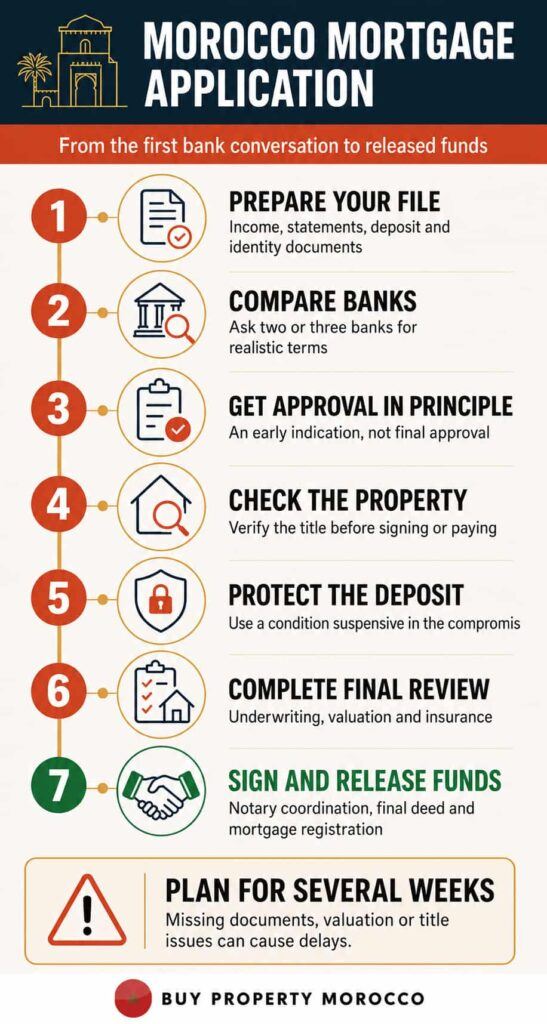
The Stages Behind the Word Approval
- First conversation. A branch gives you an informal view of what may be possible.
- Agreement in principle. The bank signals interest on limited information, subject to everything that follows.
- Complete file and underwriting. The bank checks income, existing debts, source of funds, and compliance requirements.
- Property valuation. An appraiser assesses the property and the bank compares that value with your price.
- Life insurance decision. The insurer reviews age and health, and may request medical checks.
- Final approval. The bank issues a formal offer stating the amount, rate, term, and conditions.
- Notary coordination and release of funds. The notary, the bank, and the seller align on the deed, the mortgage registration, and the payment.
Can a Moroccan Mortgage Be Approved in Four Days?
A preliminary response within a few days is possible when the file is complete and the profile is simple.
However, that early answer is an indication rather than a final approval.
Even a clean application can take several weeks from the first meeting to released money, so build that time into your compromis de vente.
What Usually Causes the Delay
- Missing or expired documents that nobody chased until late in the file.
- Foreign income that needs extra verification, translation, or legalisation.
- Title problems, unclear ownership, or a valuation below the agreed price.
- Insurance questions, medical review, or notary and seller scheduling.
In one of my own purchases, the seller was living in America and the whole timeline waited on his return.
I paid a goodwill deposit of about 1,000 euros to hold the deal for the month it took him to travel back, and a financing deadline would have been sitting on top of that delay.
Check ownership early, because my guide on how to check property ownership in Morocco online shows where to start.
Official Office des Changes Rules for Foreign Non Resident Buyers
Morocco has a legal framework that lets foreign non resident individuals receive dirham financing for property in the country.
The key authority for cross border money movement is the Office des Changes, because the dirham is not freely convertible.
As a result, the way you bring money in can affect your ability to send money out again when you sell.
- Foreign non resident buyers can apply for dirham mortgage financing, while their own contribution should arrive as foreign currency through official banking channels.
- You should normally use a compte en dirhams convertibles, which is a convertible dirham account.
- The bank usually takes a first rank mortgage charge over the property.
- That documented trail protects your right to repatriate capital and profit when you sell.
- The Office des Changes page on loans to non residents covers dirham loans used to finance property acquisition or construction in Morocco.
- The same page sets a limit of 80% of the property price, which is a regulatory ceiling rather than a promise of approval.
What Is the Article 203 Sworn Declaration?
Article 203 of the Office des Changes instruction sets out the documents a bank must collect before it lends.
Under that article, a bank must ask a foreign non resident applicant for a sworn declaration before granting a dirham loan to buy or build a residence in Morocco.
The declaration confirms that the applicant does not already own a residence in Morocco, while Moroccans living abroad are exempted from it under the same article.
If you already own a home in Morocco, raise it early instead of discovering the issue late in the file.
Special Dirham Account and Convertible Dirham Account Are Not the Same
Many foreign buyers mix these two accounts up, and the difference matters.
| Account | What It Usually Holds | Why It Matters |
|---|---|---|
| Special dirham account | The dirham loan released by the bank to a foreign non resident borrower. | No transfer abroad is permitted from this account under the framework. |
| Convertible dirham account | Foreign currency you send into Morocco for your own contribution and repayments. | It creates the paper trail behind your later repatriation rights. |
Under the same Article 203, repatriation after a sale is normally limited to your initial foreign currency contribution, the principal you repaid using foreign currency or a convertible dirham account, and any capital gain.
Therefore, confirm your own position with your bank and the Office des Changes before you move serious money.
If you are still mapping out the wider process, my guide on buying property in Morocco as a foreigner covers the steps before financing.
Do Not Sign the Compromis de Vente Without a Financing Condition
If you depend on a mortgage, the financing protection must be written into the compromis de vente before you sign or pay a deposit.
The relevant clause is normally called a condition suspensive de financement.
It explains what should happen if you submit a genuine mortgage application and the bank refuses the loan within the agreed period.
With properly drafted protection the sale may be cancelled and the deposit returned, while without it the deposit may stay at risk even when the application fails.
The clause should state the loan amount sought, the financing deadline, the number of banks that must be approached, the evidence of refusal required, and the process for returning the deposit.
Some clauses name only one lender, which leaves you exposed if that single bank says no.
Ask your Moroccan notary or an independent lawyer to settle the number of banks, the deadline, the proof of refusal, and the return of your deposit.
Finally, do not rely on a verbal promise from an agent or seller that the deposit will be returned.
Real Costs: What Will You Actually Pay?
Mortgage cost is only one part of the purchase, so plan for three separate groups of cost.
Mandatory acquisition costs apply to almost every purchase, conditional costs depend on the agreements you make, and mortgage related costs apply only when you borrow.
| Group | Cost Item | Estimated Amount | Paid To |
|---|---|---|---|
| Mandatory | Property registration tax | Often around 4% for standard property, with exceptions by property type. | Moroccan tax authority. |
| Mandatory | Land registration fee | Often around 1% to 1.5%. | ANCFCC. |
| Mandatory | Notary fees plus VAT | Often around 0.5% to 1.5%. | Notary. |
| Conditional | Buyer side agency commission | Often around 2.5% to 3%, and only when you agree to pay it. | Real estate agent. |
| Mortgage related | Mortgage arrangement fee | Often around 1% to 1.5% of the loan amount. | Bank. |
| Mortgage related | Property valuation | Working estimate: MAD 2,000 to MAD 5,000. | Valuation expert. |
| Mortgage related | Loan life insurance | Priced by age, health, loan amount, and term. | Insurer. |
| Mortgage related | Mortgage registration and formalities | Verify the current amounts with the bank and the notary. | Tax authority, registry, or notary. |
As a cautious planning range, budget about 8% to 12% of the purchase price when a buyer side agency fee and mortgage related costs both apply.
That range is a planning estimate rather than a fixed legal charge.
A cash buyer with no buyer side agency fee usually pays less, because the mortgage and agency items disappear.
Your exact total still depends on the property, the bank, the notary, the agency agreement, and the mortgage.
The 2026 Payment Traceability Rule
From July 1, 2026, an additional registration duty of 2% can apply to property transactions above MAD 300,000 in certain cases.
It can apply when the deed does not identify the payment method and its references correctly, or when payment is made by a method that is not accepted as traceable under the applicable rules.
Where only part of the price is affected, the additional 2% applies to that affected amount.
Therefore, pay through properly documented banking channels and check that the notarial deed records the payment method and references.
This does not mean every buyer pays the extra 2%, so confirm your own position with your notary and the official Ministry of Finance note on the 2026 finance law measures.
When I bought my first apartment in Marrakech, the notary bill was not one single fee, because there was a registration cost, a separate land registration cost, and the notary’s own charge on top.
That is why I ask the notary for exact figures in advance rather than budgeting the agreed price alone.
Working Budget Example for a MAD 2,000,000 Purchase

| Item | Amount | Notes |
|---|---|---|
| Purchase price | MAD 2,000,000 | Agreed price with seller. |
| Buyer contribution at 40% | MAD 800,000 | Must be documented through official banking channels. |
| Possible loan at 60% | MAD 1,200,000 | Only if the bank accepts the value and your profile. |
| Estimated additional costs at 8% to 12% | MAD 160,000 to MAD 240,000 | Registration, land registration, notary, agency, and mortgage related items. |
| Estimated total cash before renovation and furniture | MAD 960,000 to MAD 1,040,000 | Buyer contribution plus estimated additional costs. |
These figures remain planning estimates, and a lower bank valuation would mean a smaller loan with a larger buyer contribution.
The example also excludes renovation, furniture, municipal taxes, property management, and currency transfer costs.
Mortgage Contract Terms to Check Before You Sign
The interest rate is only one line in a mortgage contract.
Most unpleasant surprises come from the clauses buyers never read.
Questions to Ask Before You Apply
- Do you finance foreign non resident individuals, or only Moroccan residents and MREs?
- Which borrower category will you place me in, and what is the maximum loan to value for that profile?
- Is that percentage based on the purchase price, deed value, total project cost, or bank valuation?
- Can you provide written approval in principle before I sign a compromis de vente?
- Which foreign documents must be translated or legalised, and which stages can be completed from abroad?
- How long does final approval take, and which conditions must be met before the funds are released?
Repayment, Rate and Insurance Clauses
- Can you repay the loan in full or in part early, with how much notice, and at what cost?
- Is the rate fixed, variable, or fixed for an initial period only?
- Is salary domiciliation required, and for how long?
- Which life insurance policy is required, and can you choose the insurer?
Early Repayment Under Article 132
Article 132 of Moroccan Law 31-08 gives borrowers a right to repay early on consumer property loans that fall within its scope.
The borrower may repay the loan partly or fully before the end of the term.
However, a contract may still restrict partial repayments equal to or below 10% of the original loan amount, unless the payment clears the remaining balance.
Where the contract allows the lender to claim compensation for interest that has not yet fallen due, that compensation cannot exceed 2% of the outstanding principal.
Scope matters here, because loans taken to finance a professional activity sit outside this chapter of the law.
Ask the bank for the exact early repayment clause in writing, then confirm it with a qualified Moroccan lawyer or notary.
The text is published by ACAPS in Law 31-08 on consumer protection measures.
Valuation, Appraiser and Release of Funds
The lending bank normally relies on an appraiser it appoints or accepts.
- Who appoints the appraiser, who pays the fee, and can you review the report?
- What happens if the value comes in below the purchase price?
- What financing deadline does the compromis de vente set, and what happens if the bank misses it?
When I bought in Marrakech, the asking price moved from about 85,000 euros to 75,000 euros before we finally agreed at 70,000 euros.
That gap is a reminder that an asking price is an opinion, while a bank valuation is a decision that costs you cash.
Since the bank secures its loan on the registered title, my explanation of what a titre foncier means for foreign buyers in Marrakech is worth reading alongside this.
Can You Finance the Purchase Through a Bank in Your Home Country?
A Moroccan mortgage is not the only possible financing route.
Some buyers borrow against a property or another asset where they live, or refinance an existing home and use the released funds.
That route can simplify the Moroccan purchase, because you avoid waiting for a Moroccan bank to approve both the borrower and the property.
However, the funds should still enter Morocco through official banking channels, with transfer confirmations and foreign currency import documents kept safely.
The main tradeoff is that the debt may be secured against an asset in another country rather than against the Moroccan property.
Compare the interest rate, currency risk, early repayment charges, tax implications, and the effect of the additional debt before choosing this route.
A qualified adviser familiar with cross border property finance can compare the total cost of both routes.
Which Properties Do Moroccan Banks Refuse?
A strong buyer profile is not enough, because the property must pass the bank review too.
Title and Permit Problems That Stop Financing
- No clear titre foncier: Banks need a registered title to secure their mortgage.
- Melkia only ownership: Melkia carries major risk and is often not acceptable for bank financing.
- Inheritance disputes: Unresolved heirs can stop the bank from lending.
- Seller mismatch: If the seller is not clearly the registered owner, the file becomes dangerous.
- Missing permits: Off plan projects without proper permits may be refused, so read my guide on buying off plan property in Morocco first.
- Undisclosed charges: Existing mortgages or tax debts must be cleared before a new mortgage can be registered.
- Illegal extensions: Plans that do not match the building make the bank nervous.
Do not assume a property is financeable because an agent or developer says it is.
Run full property due diligence, including an ANCFCC title check, before you pay any serious deposit.
Can Foreigners Get a Mortgage for a Riad in Marrakech?
Yes, foreigners can sometimes finance a riad in Marrakech, though the answer depends on the specific property.
A riad with a clean registered titre foncier is much easier to finance.
Meanwhile, a Melkia only riad, an inherited riad with unresolved heirs, or an unregistered medina property can be refused outright.
- A riad with multiple heirs can take months or years to clean up legally.
- The legal risks of buying a riad in Marrakech rise sharply when the title is unclear.
- Before paying anything, study how to buy a riad in Marrakech safely.
- The seller wants cash or payment outside Morocco, or refuses an ANCFCC title search.
- The seller is not the person named on the title.
- A price is far below market without a clear reason.
- No notary is involved, or you are pressured to sign today.
Book a Free 15 Minute Morocco Buyer Call
Bring the property, the price and the stage you have reached.
You will get buyer side clarity on the title questions, the deposit risk and what to confirm with your notary and your bank first.
The call is free and lasts 15 minutes, and it is not mortgage approval, bank representation, legal advice or a property inspection.
The Mortgage Mistakes Foreign Buyers Make Most Often
- Signing before financing is protected. Always use a condition suspensive if you need a mortgage.
- Paying a deposit too early. Read my guide on property deposits in Morocco for foreigners before sending money.
- Not checking the title. Use my guide on how to verify title deed before buying property in Morocco.
- Assuming advertised financing is guaranteed. Product pages show maximums, not automatic approvals.
- Using informal money transfers. This can hurt repatriation later and can now cost extra registration duty.
- Relying on rental projections to qualify. Banks usually want existing documented income.
- Ignoring the bank valuation. A low valuation can force you to bring much more cash, and the notary is essential without being your personal lawyer.
Before sending any money, read my guide on how to avoid property scams in Morocco.
What I Have Personally Learned From Buying Property in Morocco

I have bought four properties in Morocco and seen how quickly a nice property makes people forget the boring checks that protect their money.
Agents and sellers can make a buyer feel the property will disappear unless they move fast.
Speed helps the seller far more than it helps the buyer.
One of my purchases came with a shop that was already rented to a tenant.
The tenant refused to sign a new contract, and his lawyer later explained that the existing lease stayed in place until the property was registered in my name.
Even cash buyers need to care about banking rules.
If money is not brought into Morocco properly, selling and repatriating funds becomes painful later.

- Many medina properties in Marrakech and Fes are hard to finance because the title is not clean enough for a bank.
- The dirham is controlled, so your money trail matters from the first transfer.
- Power of attorney should be specific and limited if you cannot be present.
Frequently Asked Questions
Can foreigners, expats and non residents get a mortgage in Morocco?
Yes, all three groups can apply, whether they live in Morocco or abroad, although approval depends on income, deposit, property title, valuation, documents, and bank policy.
Which Moroccan banks consider foreign buyers?
Bank of Africa publishes a product that names foreign non residents, while CIH publishes an acquisition product whose eligibility for a foreign non resident applicant must be confirmed with the bank.
Other large Moroccan banks may consider foreign files case by case.
Can I apply for a Moroccan mortgage from abroad?
Often yes, because you can usually begin with a bank’s international or non resident department before you travel.
However, the bank may still require you to be present for identity checks, account opening, or signing.
Can I get a Moroccan mortgage without a residency card?
Foreign non residents can apply for certain Moroccan mortgage products without holding a Moroccan residency card.
The file will still depend on verifiable foreign income, clean statements, a documented source of funds, and a sufficient contribution.
Are MRE conditions the same as conditions for foreign non residents?
No, because MREs are Moroccans living abroad and often have dedicated products, so do not use an MRE advertisement to estimate your own financing.
Can US, UK and EU citizens apply?
Yes, US citizens can apply, though some banks add compliance checks because of FATCA rules.
UK citizens can apply as well, and so can EU citizens, with no automatic advantage for either.
Can I use foreign income, and can a self employed buyer qualify?
Yes, foreign salary, pension, or business income is usually accepted when the documents are clear and verifiable.
Self employed buyers can qualify too, although banks ask for tax returns, company accounts, and an accountant letter.
No published minimum income applies to every bank, so ask each lender how much of your income can go to repayments.
Is a Moroccan work contract, guarantor or credit score required?
No Moroccan employment contract is required for a non resident relying on foreign income, and a guarantor is not a universal requirement.
Morocco does run a formal credit risk reporting system, because Bank Al Maghrib operates the centralisation of credit risk information, while Creditinfo Maroc and Quantik operate as credit bureaus.
A foreign non resident usually has no Moroccan credit history, so banks may ask for foreign credit reports, bank references, and repayment history instead.
Can spouses combine their income?
Some Moroccan banks allow two applicants to apply together, which can raise the amount considered.
Ask whether both must sign the loan, appear on the title, and take life insurance.
How much deposit is required, and what rates should I expect?
Foreign non resident buyers should plan for roughly 30% to 50% of the price in documented cash, and sometimes more.
Bank Al Maghrib reported an average real estate loan rate of around 5.13% for Q1 2026, yet a foreign non resident file can be priced higher.
Can projected rental or Airbnb income be used to qualify?
Usually no, because Moroccan banks normally want existing documented income rather than projections.
Financing an investment property is still possible, although a foreign non resident financing a residence signs the Article 203 declaration, so confirm how the bank classifies your intended use.
Can foreigners use participatory or Islamic property finance in Morocco?
Participatory banking exists in Morocco, and participatory property finance usually uses structures such as Mourabaha rather than an interest bearing loan.
Availability for a foreign non resident buyer must be confirmed directly with the relevant participatory bank.
Do not assume a product is participatory because of its name, since a conventional loan can still carry an Arabic brand name.
What happens if the bank refuses after I sign the compromis?
With a proper condition suspensive for mortgage refusal, you may be able to cancel under that condition.
Without that protection, your deposit may be at risk.
What happens to my Moroccan mortgage if I sell the property?
A property with an outstanding mortgage can normally be sold, but the registered mortgage must be settled and discharged as part of the transaction.
The notary coordinates with the bank, and part of the sale proceeds repays the remaining loan before the balance reaches the seller.
Keep the purchase deed, transfer confirmations, currency import documents, and the final sale deed for the repatriation file.
Is it safe to buy property in Morocco as a foreigner?
It can be safe with the right process, but you must verify title, funds, notary steps, tax position, and bank terms.
For the broader question, read my guide on whether it is safe to buy property in Morocco as a foreigner.
Book a Free 15 Minute Morocco Buyer Call Before You Commit
Tell Anis what you want to buy, your budget and where you are in the process.
You will leave with sharper questions for the bank, the notary and the seller.
The call is free, lasts 15 minutes, and offers practical buyer guidance rather than legal, tax, financial or mortgage advice.

Anis is the founder of Buy Property Morocco, a research-based resource created to help foreign buyers understand the real process of buying property in Morocco safely.
He focuses on the practical details most buyers only discover too late: title deed checks, notary steps, compromis de vente risks, transfer taxes, foreign banking rules, repatriating money after a sale, and avoiding common mistakes when dealing with agents or sellers.
Anis has personally bought 4 properties in Morocco and shares practical guidance based on real experience, not theory.
If you are seriously considering buying property in Morocco and want private guidance before you send money, pay a deposit, or sign anything, you can book a buyer safety call here: